


Page 190 - Berkshire Encyclopedia Of World History Vol I - Abraham to Coal
P. 190
alcohol 75


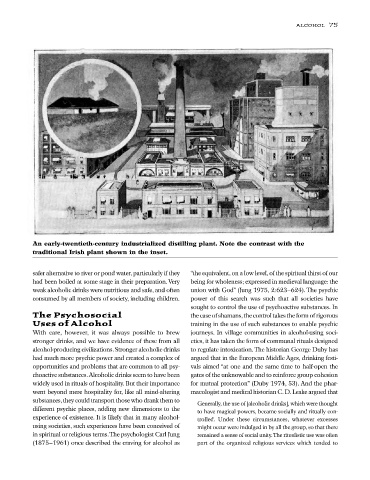
            An early-twentieth-century industrialized distilling plant. Note the contrast with the
            traditional Irish plant shown in the inset.


            safer alternative to river or pond water, particularly if they  “the equivalent,on a low level,of the spiritual thirst of our
            had been boiled at some stage in their preparation.Very  being for wholeness; expressed in medieval language: the
            weak alcoholic drinks were nutritious and safe, and often  union with God” (Jung 1975, 2:623–624).The psychic
            consumed by all members of society, including children.  power of this search was such that all societies have
                                                                sought to control the use of psychoactive substances. In
            The Psychosocial                                    the case of shamans,the control takes the form of rigorous
            Uses of Alcohol                                     training in the use of such substances to enable psychic
            With care, however, it was always possible to brew  journeys. In village communities in alcohol-using soci-
            stronger drinks, and we have evidence of these from all  eties, it has taken the form of communal rituals designed
            alcohol-producing civilizations.Stronger alcoholic drinks  to regulate intoxication.The historian George Duby has
            had much more psychic power and created a complex of  argued that in the European Middle Ages, drinking festi-
            opportunities and problems that are common to all psy-  vals aimed “at one and the same time to half-open the
            choactive substances.Alcoholic drinks seem to have been  gates of the unknowable and to reinforce group cohesion
            widely used in rituals of hospitality. But their importance  for mutual protection” (Duby 1974, 53). And the phar-
            went beyond mere hospitality for, like all mind-altering  macologist and medical historian C.D.Leake argued that
            substances,they could transport those who drank them to
                                                                  Generally,the use of [alcoholic drinks],which were thought
            different psychic places, adding new dimensions to the
                                                                  to have magical powers, became socially and ritually con-
            experience of existence. It is likely that in many alcohol-  trolled. Under these circumstances, whatever excesses
            using societies, such experiences have been conceived of  might occur were indulged in by all the group, so that there
            in spiritual or religious terms.The psychologist Carl Jung  remained a sense of social unity.The ritualistic use was often
            (1875–1961) once described the craving for alcohol as  part of the organized religious services which tended to

