


Page 127 - Encyclopedia Of World History Vol III
P. 127
946 berkshire encyclopedia of world history


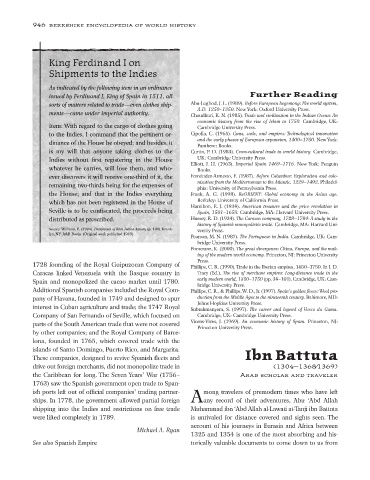
                 King Ferdinand I on
                 Shipments to the Indies


                 As indicated by the following item in an ordinance
                 issued by Ferdinand I, King of Spain in 1511, all                  Further Reading
                 sorts of matters related to trade—even clothes ship-  Abu-Lughod, J. L. (1989). Before European hegemony:The world system,
                                                                  A.D. 1250–1350. New York: Oxford University Press.
                 ments—came under imperial authority.           Chaudhuri, K. N. (1985). Trade and civilization in the Indian Ocean: An
                                                                  economic history from the rise of Islam to 1750. Cambridge, UK:
                 Item: With regard to the cargo of clothes going  Cambridge University Press.
                 to the Indies, I command that the pertinent or-  Cipolla, C. (1965). Guns, sails, and empires: Technological innovation
                                                                  and the early phases of European expansion, 1400–1700. New York:
                 dinance of the House be obeyed; and besides, it
                                                                  Pantheon Books.
                 is my will that anyone taking clothes to the   Curtin, P. D. (1984). Cross-cultural trade in world history. Cambridge,
                 Indies without first registering in the House     UK: Cambridge University Press.
                                                                Elliott, J. H. (1963). Imperial Spain 1469–1716. New York: Penguin
                 whatever he carries, will lose them, and who-    Books.
                 ever discovers it will receive one-third of it, the  Fernández-Armesto, F. (1987). Before Columbus: Exploration and colo-
                                                                  nization from the Mediterranean to the Atlantic, 1229–1492. Philadel-
                 remaining two-thirds being for the expenses of
                                                                  phia: University of Pennsylvania Press.
                 the House; and that in the Indies everything   Frank, A. G. (1998). ReORIENT: Global economy in the  Asian age.
                 which has not been registered in the House of    Berkeley: University of California Press.
                                                                Hamilton, E. J. (1934). American treasure and the price revolution in
                 Seville is to be confiscated, the proceeds being  Spain, 1501–1650. Cambridge, MA: Harvard University Press.
                 distributed as prescribed.                     Hussey, R. D. (1934). The Caracas company, 1728–1784:A study in the
                                                                  history of Spanish monopolistic trade. Cambridge, MA: Harvard Uni-
                 Source: Williams, E. (1994). Documents of West Indian history (p. 180). Brook-  versity Press.
                 lyn, NY: A&B Books. (Original work published 1963)
                                                                Pearson, M. N. (1987). The Portuguese in India. Cambridge, UK: Cam-
                                                                  bridge University Press.
                                                                Pomeranz, K. (2000). The great divergence: China, Europe, and the mak-
                                                                  ing of the modern world economy. Princeton, NJ: Princeton University
                                                                  Press.
            1728 founding of the Royal Guipuzocan Company of    Phillips, C. R. (1990).Trade in the Iberian empires, 1450–1750. In J. D.
            Caracas linked Venezuela with the Basque country in   Tracy (Ed.), The rise of merchant empires: Long-distance trade in the
                                                                  early modern world, 1350–1750 (pp. 34–101). Cambridge, UK: Cam-
            Spain and monopolized the cacao market until 1780.
                                                                  bridge University Press.
            Additional Spanish companies included the Royal Com-  Phillips, C. R., & Phillips,W. D., Jr. (1997). Spain’s golden fleece:Wool pro-
            pany of Havana, founded in 1749 and designed to spur  duction from the Middle Ages to the nineteenth century. Baltimore, MD:
                                                                  Johns Hopkins University Press.
            interest in Cuban agriculture and trade; the 1747 Royal  Subrahmanyam, S. (1997). The career and legend of Vasco da Gama.
            Company of San Fernando of Seville, which focused on  Cambridge, UK: Cambridge University Press.
                                                                Vicens-Vives, J. (1969). An economic history of Spain. Princeton, NJ:
            parts of the South American trade that were not covered
                                                                  Princeton University Press.
            by other companies; and the Royal Company of Barce-
            lona, founded in 1765, which covered trade with the
            islands of Santo Domingo, Puerto Rico, and Margarita.
            These companies, designed to revive Spanish fleets and                 Ibn Battuta
            drive out foreign merchants, did not monopolize trade in                       (1304–1368/1369)
            the Caribbean for long. The Seven Years’ War (1756–                 Arab scholar and traveler
            1763) saw the Spanish government open trade to Span-
            ish ports left out of official companies’ trading partner-  mong travelers of premodern times who have left
            ships. In 1778, the government allowed partial foreign Aany record of their adventures, Abu  ‘Abd  Allah
            shipping into the Indies and restrictions on free trade  Muhammad ibn ‘Abd Allah al-Lawati at-Tanji ibn Battuta
            were lifted completely in 1789.                     is unrivaled for distance covered and sights seen. The
                                                                account of his journeys in Eurasia and Africa between
                                              Michael A. Ryan
                                                                1325 and 1354 is one of the most absorbing and his-
            See also Spanish Empire                             torically valuable documents to come down to us from

