


Page 137 - Encyclopedia Of World History Vol III
P. 137
956 berkshire encyclopedia of world history


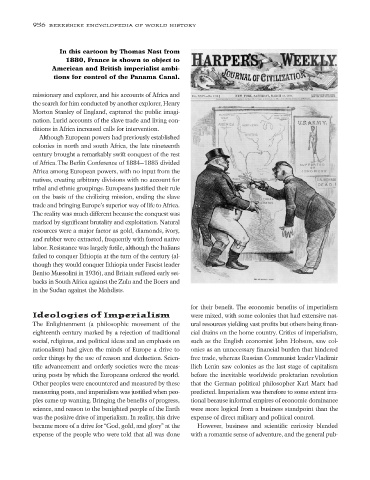
                     In this cartoon by Thomas Nast from
                       1880, France is shown to object to
                  American and British imperialist ambi-
                   tions for control of the Panama Canal.


            missionary and explorer, and his accounts of Africa and
            the search for him conducted by another explorer, Henry
            Morton Stanley of England, captured the public imagi-
            nation. Lurid accounts of the slave trade and living con-
            ditions in Africa increased calls for intervention.
              Although European powers had previously established
            colonies in north and south Africa, the late nineteenth
            century brought a remarkably swift conquest of the rest
            of Africa.The Berlin Conference of 1884–1885 divided
            Africa among European powers, with no input from the
            natives, creating arbitrary divisions with no account for
            tribal and ethnic groupings. Europeans justified their rule
            on the basis of the civilizing mission, ending the slave
            trade and bringing Europe’s superior way of life to Africa.
            The reality was much different because the conquest was
            marked by significant brutality and exploitation. Natural
            resources were a major factor as gold, diamonds, ivory,
            and rubber were extracted, frequently with forced native
            labor. Resistance was largely futile, although the Italians
            failed to conquer Ethiopia at the turn of the century (al-
            though they would conquer Ethiopia under Fascist leader
            Benito Mussolini in 1936), and Britain suffered early set-
            backs in South Africa against the Zulu and the Boers and
            in the Sudan against the Mahdists.


                                                                for their benefit. The economic benefits of imperialism
            Ideologies of Imperialism                           were mixed, with some colonies that had extensive nat-
            The Enlightenment (a philosophic movement of the    ural resources yielding vast profits but others being finan-
            eighteenth century marked by a rejection of traditional  cial drains on the home country. Critics of imperialism,
            social, religious, and political ideas and an emphasis on  such as the English economist John Hobson, saw col-
            rationalism) had given the minds of Europe a drive to  onies as an unnecessary financial burden that hindered
            order things by the use of reason and deduction. Scien-  free trade, whereas Russian Communist leader Vladimir
            tific advancement and orderly societies were the meas-  Ilich Lenin saw colonies as the last stage of capitalism
            uring posts by which the Europeans ordered the world.  before the inevitable worldwide proletarian revolution
            Other peoples were encountered and measured by these  that the German political philosopher Karl Marx had
            measuring posts, and imperialism was justified when peo-  predicted. Imperialism was therefore to some extent irra-
            ples came up wanting. Bringing the benefits of progress,  tional because informal empires of economic dominance
            science, and reason to the benighted people of the Earth  were more logical from a business standpoint than the
            was the positive drive of imperialism. In reality, this drive  expense of direct military and political control.
            became more of a drive for “God, gold, and glory” at the  However, business and scientific curiosity blended
            expense of the people who were told that all was done  with a romantic sense of adventure, and the general pub-

