


Page 134 - Encyclopedia Of World History Vol III
P. 134
imperialism 953


            example, such as a particular empire or the spread of a  Origins (Sixteenth–
            particular system. Most commonly, imperialism refers to  Eighteenth Centuries)
            the particular type of political organization that emerged  The discovery of the New World opened up new paths
            during the nineteenth century, the “New Imperialism” by  for exploitation on many levels.After the initial pillage of
            which Europe established empires in Africa, Asia, and  the Aztec and Inca empires by the Spanish conquista-
            Oceania (islands of the central and south Pacific).  dors, silver mines in Bolivia and Mexico gave the Span-
              The major impact of imperialism was the spread of  ish Empire tremendous revenue. This revenue helped
            ideas among different peoples, particularly in highly cos-  finance the wars of the Habsburg (a European ruling
            mopolitan empires. Empires operate on two key princi-  house) against European rivals such as the Dutch, Eng-
            ples: acquisition of wealth,whether in money or in other  lish, and Ottoman Turks. Spain was ultimately overex-
            resources, and the spread of belief systems to other peo-  tended by these wars, and the Habsburg emperors found
            ples in order to establish unity under one imperial struc-  such a large empire difficult to manage effectively. Spain’s
            ture.This structure comes with an attendant worldview  rivals also set about exploiting the New World and
            on religious, social, cultural, and political matters that  pushed into the Indian Ocean and the Pacific as well.
            subjects of the empire are expected to accept or at least  The biological consequences of the conquest were much
            accommodate. Internal conflicts within empires usually  more profound in the long run than was silver. Old
            come as a result of resistance to the imperial worldview  World diseases decimated up to 90 percent of the native
            by subject peoples. Modern empires built upon these  population, leading to the importation of African slaves
            foundations and added more sophisticated bureaucratic  to labor on the new sugar, cotton, and tobacco planta-
            structures and explicit drives for religious conversion, par-  tions. New crops, such as maize and the potato, were
            ticularly Islam and Christianity. Improved means of trans-  exported to the Old World, allowing for diversified agri-
            portation, particularly sailing and later steam vessels,  culture and large population growth. This package of
            and the discovery of the New World added opportuni-  crops would also allow Europeans to establish them-
            ties for overseas expansion and more diverse empires.  selves in areas with similar climates, opening up areas of
                                                                                       settlement in the  Americas,
                                                                                       South Africa, and Australia.
                                                                                       The increase in population
                                                                                       and resources promoted in-
                                                                                       creased trade as demand went
                                                                                       up and new opportunities for
                                                                                       trade were opened.


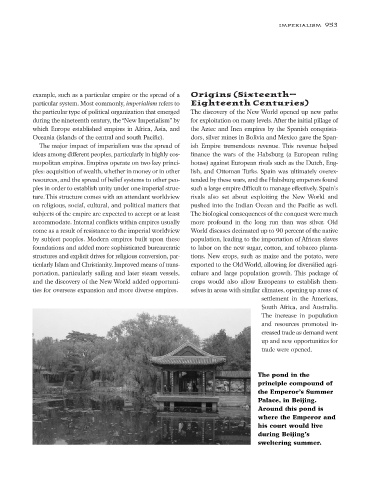
                                                                                      The pond in the
                                                                                      principle compound of
                                                                                      the Emperor’s Summer
                                                                                      Palace, in Beijing.
                                                                                      Around this pond is
                                                                                      where the Emperor and
                                                                                      his court would live
                                                                                      during Beijing’s
                                                                                      sweltering summer.

