


Page 180 - Encyclopedia Of World History Vol III
P. 180
inner eurasia 999


            grain-based agriculture, bypassed most of Inner Eurasia.  4000 BCE, people began to exploit not just those prod-
            So, while agriculture spread in much of Outer Eurasia,  ucts of livestock that could be used after an animal’s
            laying the foundations for several great agrarian civiliza-  slaughter (its skin, bones, and meat), but also the ani-
            tions, in Inner Eurasia agriculture made hardly any head-  mal’s secondary products—products such as its wool,
            way for many thousands of years. Instead, Neolithic tech-  blood, milk, and traction power—that could be used
            nologies entered Inner Eurasia in the less familiar form  while it was still alive. These techniques raised the effi-
            of pastoralism.                                     ciency with which domesticated animals could be ex-
                                                                ploited, making it possible to build entire lifeways around
            Pastoralism                                         the use of domesticated animals such as sheep, cattle,
            Unlike agricultural lifeways, which are dominated by do-  goats, horses, camels, and yaks. Pastoralism proved an
            mesticated plants, pastoral lifeways are dominated by the  effective way of exploiting the vast grasslands that
            exploitation of domesticated livestock. Pastoralism be-  stretched from Hungary to Manchuria, and, for several
            came a viable lifeway as a result of a series of innovations  thousand years, it was the dominant lifeway throughout
            that the archaeologist Andrew Sherratt has described as  this region. The earliest evidence of pastoralism comes
            the secondary-products revolution. Beginning around  from the Sredny Stog cultures of eastern Ukraine, which


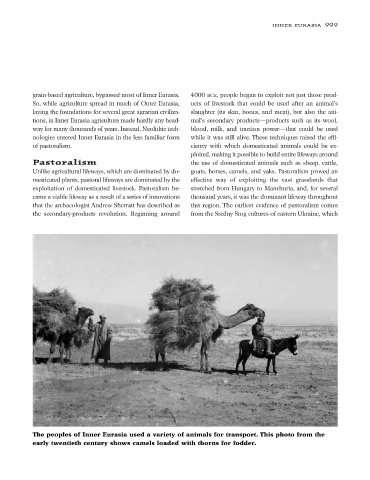
            The peoples of Inner Eurasia used a variety of animals for transport. This photo from the
            early twentieth century shows camels loaded with thorns for fodder.

