


Page 218 - Encyclopedia Of World History Vol III
P. 218
islamic world 1037


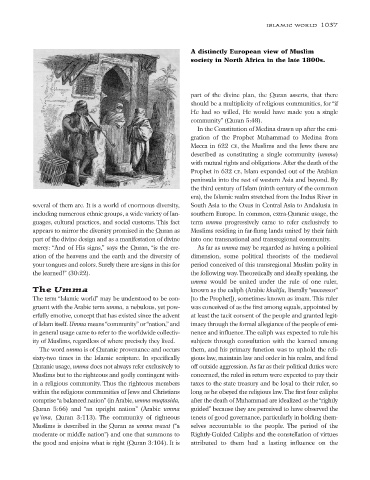
                                                                A distinctly European view of Muslim
                                                                society in North Africa in the late 1800s.


                                                                part of the divine plan, the Quran asserts, that there
                                                                should be a multiplicity of religious communities, for “if
                                                                He had so willed, He would have made you a single
                                                                community” (Quran 5:48).
                                                                  In the Constitution of Medina drawn up after the emi-
                                                                gration of the Prophet Muhammad to Medina from
                                                                Mecca in 622 CE, the Muslims and the Jews there are
                                                                described as constituting a single community (umma)
                                                                with mutual rights and obligations.After the death of the
                                                                Prophet in 632 CE, Islam expanded out of the Arabian
                                                                peninsula into the rest of western Asia and beyond. By
                                                                the third century of Islam (ninth century of the common
                                                                era), the Islamic realm stretched from the Indus River in
            several of them are. It is a world of enormous diversity,  South Asia to the Oxus in Central Asia to Andalusia in
            including numerous ethnic groups, a wide variety of lan-  southern Europe. In common, extra-Quranic usage, the
            guages, cultural practices, and social customs. This fact  term  umma progressively came to refer exclusively to
            appears to mirror the diversity promised in the Quran as  Muslims residing in far-flung lands united by their faith
            part of the divine design and as a manifestation of divine  into one transnational and transregional community.
            mercy: “And of His signs,” says the Quran, “is the cre-  As far as umma may be regarded as having a political
            ation of the heavens and the earth and the diversity of  dimension, some political theorists of the medieval
            your tongues and colors. Surely there are signs in this for  period conceived of this transregional Muslim polity in
            the learned!” (30:22).                              the following way.Theoretically and ideally speaking, the
                                                                umma would be united under the rule of one ruler,
            The Umma                                            known as the caliph (Arabic khalifa, literally “successor”
            The term “Islamic world” may be understood to be con-  [to the Prophet]), sometimes known as imam.This ruler
            gruent with the Arabic term umma, a nebulous, yet pow-  was conceived of as the first among equals, appointed by
            erfully emotive, concept that has existed since the advent  at least the tacit consent of the people and granted legit-
            of Islam itself. Umma means “community” or “nation,” and  imacy through the formal allegiance of the people of emi-
            in general usage came to refer to the worldwide collectiv-  nence and influence.The caliph was expected to rule his
            ity of Muslims, regardless of where precisely they lived.  subjects through consultation with the learned among
              The word umma is of Quranic provenance and occurs  them, and his primary function was to uphold the reli-
            sixty-two times in the Islamic scripture. In specifically  gious law, maintain law and order in his realm, and fend
            Quranic usage, umma does not always refer exclusively to  off outside aggression.As far as their political duties were
            Muslims but to the righteous and godly contingent with-  concerned, the ruled in return were expected to pay their
            in a religious community. Thus the righteous members  taxes to the state treasury and be loyal to their ruler, so
            within the religious communities of Jews and Christians  long as he obeyed the religious law.The first four caliphs
            comprise “a balanced nation” (in Arabic, umma muqtasida,  after the death of Muhammad are idealized as the “rightly
            Quran 5:66) and  “an upright nation” (Arabic  umma  guided” because they are perceived to have observed the
            qa’ima, Quran 3:113). The community of righteous    tenets of good governance, particularly in holding them-
            Muslims is described in the Quran as umma wasat (“a  selves accountable to the people. The period of the
            moderate or middle nation”) and one that summons to  Rightly-Guided Caliphs and the constellation of virtues
            the good and enjoins what is right (Quran 3:104). It is  attributed to them had a lasting influence on the

