


Page 389 - Between One and Many The Art and Science of Public Speaking
P. 389
Speaking of . . .


                  Learning and Enjoyment
                  Jack Peters, Yosemite Tour Guide

                                                           Consider what Jack Peters, a Yosemite National Park tour guide has
                                                           to say about his experience as an informative presenter:
                                                             Like many people before me I wandered into Yosemite National
                                                           Park for a visit and ended up living and working there. My degree in
                                                           economics didn’t really prepare me to be a tour guide, so I started
                                                           from the bottom up in my training. First I listened to, and sometimes
                                                           copied, other people’s tours until I developed my own narrative style
                                                           and informational content. In my line of work, style and substance
                                                           often share equal importance as communication tools. If the guests
                                                           relate to you personally, that is how you present the material; they
                                                           will be more receptive to and retain more of the information you put
                                                           forward. The inevitable question at day’s end is “did you enjoy the
                                                           tour?” rather than “what did you learn?” Learning and enjoying do
                                                           not have to be mutually exclusive, as we all know.
                                                             The importance of communication should be self-evident. The
                                                           better we communicate, the more we understand about our world,
                                                           and ultimately, ourselves. So I just go up to that microphone and
                                                           let ’er rip!


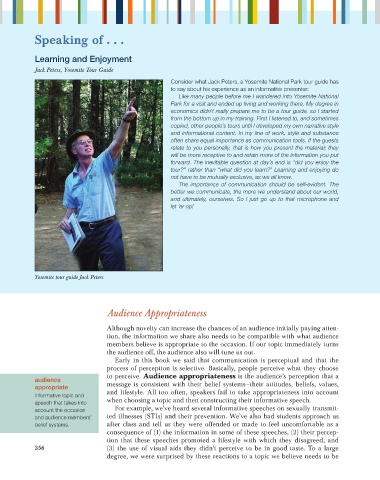
                  Yosemite tour guide Jack Peters


                                        Audience Appropriateness

                                        Although novelty can increase the chances of an audience initially paying atten-
                                        tion, the information we share also needs to be compatible with what audience
                                        members believe is appropriate to the occasion. If our topic immediately turns
                                        the audience off, the audience also will tune us out.
                                          Early in this book we said that communication is perceptual and that the
                                        process of perception is selective. Basically, people perceive what they choose
                                        to perceive. Audience appropriateness is the audience’s perception that a
                  audience
                  appropriate           message is consistent with their belief systems—their attitudes, beliefs, values,
                                        and lifestyle. All too often, speakers fail to take appropriateness into account
                  Informative topic and
                  speech that takes into   when choosing a topic and then constructing their informative speech.
                  account the occasion    For example, we’ve heard several informative speeches on sexually transmit-
                  and audience members’   ted illnesses (STIs) and their prevention. We’ve also had students approach us
                  belief systems.       after class and tell us they were offended or made to feel uncomfortable as a
                                        consequence of (1) the information in some of these speeches, (2) their percep-
                                        tion that these speeches promoted a lifestyle with which they disagreed, and
                  356                   (3) the use of visual aids they didn’t perceive to be in good taste. To a large
                                        degree, we were surprised by these reactions to a topic we believe needs to be

