


Page 395 - Between One and Many The Art and Science of Public Speaking
P. 395
In Their Own Words


                  Sample Informative Speech Outline


                                                  BEES AND
                                                  BEEKEEPING
                                                  by Trevor Morgan

                                                  Specifi c  Purpose: To
                                                  discuss a different side
                                                  of bees and beekeeping
                                                  that is less well-known to
                                                  most people.

                                                  Introduction
                  Notice how the speaker both gains    I.   Open with

                  attention and connects with the    Impact/Connect
                  audience.                          with Audience:
                                                     A show of hands:
                                                     How many people
                                                     do not like or are
                                                     even scared of bees?
                                                   II.   Thesis Statement:
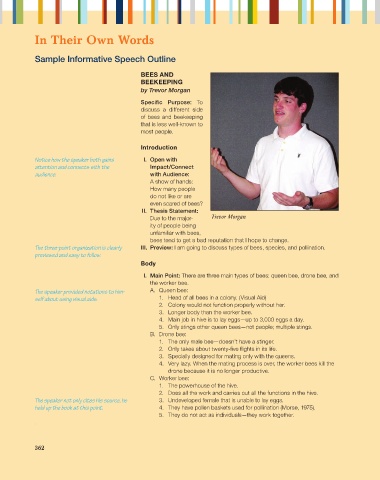
                                                     Due to the major-  Trevor Morgan
                                                     ity of people being
                                                     unfamiliar with bees,
                                                     bees tend to get a bad reputation that I hope to change.
                  The three-point organization is clearly     III.  Preview: I am going to discuss types of bees, species, and pollination.
                  previewed and easy to follow.
                                                  Body
                                                   I.   Main Point: There are three main types of bees: queen bee, drone bee, and
                                                     the worker bee.
                  The speaker provided notations to him-  A. Queen bee:
                  self about using visual aids.        1.  Head of all bees in a colony. (Visual Aid)
                                                       2.  Colony would not function properly without her.
                                                       3.  Longer body than the worker bee.
                                                       4.  Main job in hive is to lay eggs—up to 3,000 eggs a day.
                                                       5.  Only stings other queen bees—not people; multiple stings.
                                                     B. Drone bee:
                                                       1.  The only male bee—doesn’t have a stinger.
                                                       2.  Only takes about twenty-fi ve fl ights in its life.
                                                       3.  Specially designed for mating only with the queens.
                                                       4.  Very lazy. When the mating process is over, the worker bees kill the
                                                          drone because it is no longer productive.
                                                     C. Worker bee:
                                                       1.  The powerhouse of the hive.
                                                       2.  Does all the work and carries out all the functions in the hive.
                  The speaker not only cites his source, he   3.  Undeveloped female that is unable to lay eggs.
                  held up the book at this point.      4.  They have pollen baskets used for pollination (Morse, 1975).
                                                       5.  They do not act as individuals—they work together.
                  .


                  362

