


Page 397 - Between One and Many The Art and Science of Public Speaking
P. 397
364                   Part 4  Contexts for Public Speaking


                                        obtain further instruction so that they can try out the activity. For example, al-
                                        though no one can master karate from just listening to a single speech, or even a
                                        series of speeches, a demonstration of karate moves can spur an audience mem-
                                        ber to seek out individual instruction in the martial arts. In fact, many martial
                                        arts studios make a practice of giving demonstrations in schools and at public
                                        events as a way of recruiting new students.
                                          Topics for speeches that demonstrate need to be chosen with care. A com-
                                        plex, difficult task cannot be adequately demonstrated in a few minutes. There

                                        can even be the danger of making people think they know how to do something
                                        based on a speech when in fact they do not. Few of us could do CPR, for exam-
                                        ple, based on simply watching a speaker demonstrate the activity. We need the
                                        opportunity to try it out (perhaps on a life-size doll) before we can know if we
                                        can do it. On the other hand, another lifesaving technique, the Heimlich ma-
                                        neuver, is often the subject of demonstration and can be learned in a reasonably
                                        short time.
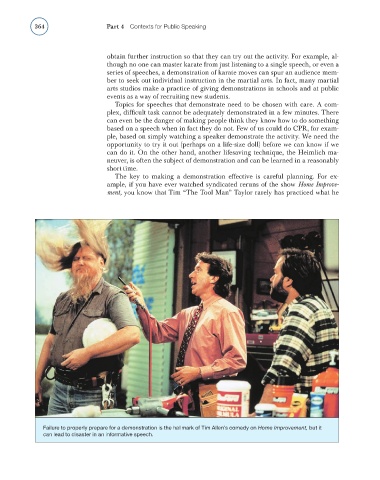
                                          The key to making a demonstration effective is careful planning. For ex-
                                        ample, if you have ever watched syndicated reruns of the show Home Improve-
                                        ment, you know that Tim “The Tool Man” Taylor rarely has practiced what he


                     Failure to properly prepare for a demonstration is the hallmark of Tim Allen’s comedy on Home Improvement, but it
                     can lead to disaster in an informative speech.

