


Page 401 - Between One and Many The Art and Science of Public Speaking
P. 401
368                   Part 4  Contexts for Public Speaking


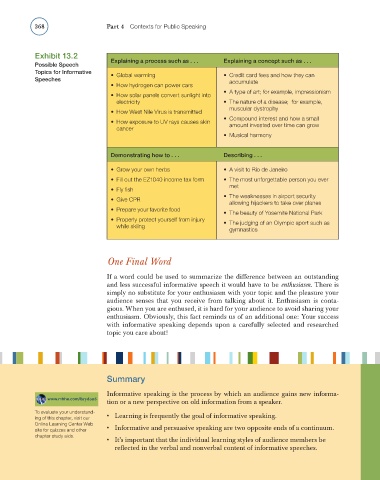
                  Exhibit 13.2
                                         Explaining a process such as . . .  Explaining a concept such as . . .
                  Possible Speech
                  Topics for Informative
                                         • Global warming                  •  Credit card fees and how they can
                  Speeches                                                  accumulate
                                         •  How hydrogen can power cars
                                                                           •  A type of art; for example, impressionism
                                         •  How solar panels convert sunlight into
                                           electricity                     •  The nature of a disease;  for example,
                                                                            muscular dystrophy
                                         •  How West Nile Virus is transmitted
                                                                           •  Compound interest and how a small
                                         •  How exposure to UV rays causes skin   amount invested over time can grow
                                           cancer
                                                                           • Musical harmony


                                         Demonstrating how to . . .        Describing . . .
                                         •  Grow your own herbs            •  A visit to Rio de Janeiro
                                         •  Fill out the EZ1040 income tax form  •  The most unforgettable person you ever
                                                                            met
                                         • Fly fi sh
                                                                           •  The weaknesses in airport security
                                         • Give CPR
                                                                            allowing hijackers to take over planes
                                         •  Prepare your favorite food
                                                                           •  The beauty of Yosemite National Park
                                         •  Properly protect yourself from injury   •  The judging of an Olympic sport such as
                                           while skiing
                                                                            gymnastics


                                        One Final Word

                                        If a word could be used to summarize the difference between an outstanding
                                        and less successful informative speech it would have to be enthusiasm. There is
                                        simply no substitute for your enthusiasm with your topic and the pleasure your
                                        audience senses that you receive from talking about it. Enthusiasm is conta-
                                        gious. When you are enthused, it is hard for your audience to avoid sharing your
                                        enthusiasm. Obviously, this fact reminds us of an additional one: Your success
                                        with informative speaking depends upon a carefully selected and researched
                                        topic you care about!


                                        Summary

                                        Informative speaking is the process by which an audience gains new informa-
                      www.mhhe.com/brydon6
                                        tion or a new perspective on old information from a speaker.
                  To evaluate your understand-
                  ing of this chapter, visit our   •  Learning is frequently the goal of informative speaking.
                  Online Learning Center Web
                  site for quizzes and other   •  Informative and persuasive speaking are two opposite ends of a continuum.
                  chapter study aids.
                                        •  It’s important that the individual learning styles of audience members be
                                          refl ected in the verbal and nonverbal content of informative speeches.

