


Page 405 - Between One and Many The Art and Science of Public Speaking
P. 405
372                   Part  4 Contexts for Public Speaking


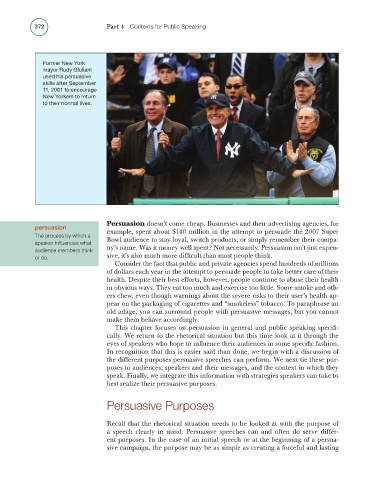
                     Former New York
                     mayor Rudy Giuliani
                     used his persuasive
                     skills after September
                     11, 2001 to encourage
                     New Yorkers to return
                     to their normal lives.


                                        Persuasion doesn’t come cheap. Businesses and their advertising agencies, for
                  persuasion
                                        example, spent about $140 million in the attempt to persuade the 2007 Super
                  The process by which a
                                        Bowl audience to stay loyal, switch products, or simply remember their compa-
                  speaker infl uences what
                                        ny’s name. Was it money well spent? Not necessarily. Persuasion isn’t just expen-
                  audience members think
                                        sive, it’s also much more diffi cult than most people think.
                  or do.
                                          Consider the fact that public and private agencies spend hundreds of millions
                                        of dollars each year in the attempt to persuade people to take better care of their
                                        health. Despite their best efforts, however, people continue to abuse their health
                                        in obvious ways. They eat too much and exercise too little. Some smoke and oth-
                                        ers chew, even though warnings about the severe risks to their user’s health ap-
                                        pear on the packaging of cigarettes and “smokeless” tobacco. To paraphrase an
                                        old adage, you can surround people with persuasive messages, but you cannot
                                        make them behave accordingly.
                                          This chapter focuses on persuasion in general and public speaking specifi -
                                        cally. We return to the rhetorical situation but this time look at it through the
                                        eyes of speakers who hope to infl uence their audiences in some specifi c fashion.
                                        In recognition that this is easier said than done, we begin with a discussion of
                                        the different purposes persuasive speeches can perform. We next tie these pur-
                                        poses to audiences, speakers and their messages, and the context in which they
                                        speak. Finally, we integrate this information with strategies speakers can take to
                                        best realize their persuasive purposes.


                                        Persuasive Purposes


                                        Recall that the rhetorical situation needs to be looked at with the purpose of
                                        a speech clearly in mind. Persuasive speeches can and often do serve differ-
                                        ent purposes. In the case of an initial speech or at the beginning of a persua-
                                        sive campaign, the purpose may be as simple as creating a forceful and lasting

