


Page 408 - Between One and Many The Art and Science of Public Speaking
P. 408
Chapter 14  Persuasive Speaking                375


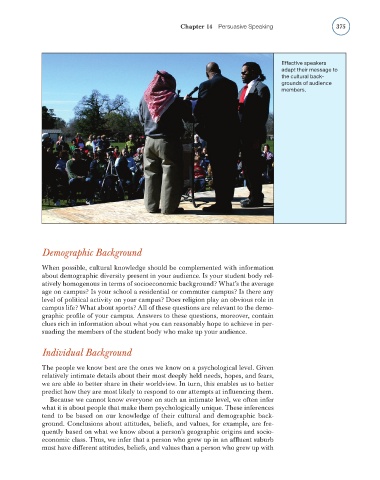
                                                                                            Effective speakers
                                                                                            adapt their message to
                                                                                            the cultural back-
                                                                                            grounds of audience
                                                                                            members.


                    Demographic Background


                    When possible, cultural knowledge should be complemented with information
                    about demographic diversity present in your audience. Is your student body rel-
                    atively homogenous in terms of socioeconomic background? What’s the average
                    age on campus? Is your school a residential or commuter campus? Is there any
                    level of political activity on your campus? Does religion play an obvious role in
                    campus life? What about sports? All of these questions are relevant to the demo-
                    graphic profi le of your campus. Answers to these questions, moreover, contain
                    clues rich in information about what you can reasonably hope to achieve in per-
                    suading the members of the student body who make up your audience.

                    Individual Background

                    The people we know best are the ones we know on a psychological level. Given
                    relatively intimate details about their most deeply held needs, hopes, and fears,
                    we are able to better share in their worldview. In turn, this enables us to better
                    predict how they are most likely to respond to our attempts at infl uencing them.
                      Because we cannot know everyone on such an intimate level, we often infer
                    what it is about people that make them psychologically unique. These inferences
                    tend to be based on our knowledge of their cultural and demographic back-
                    ground. Conclusions about attitudes, beliefs, and values, for example, are fre-
                    quently based on what we know about a person’s geographic origins and socio-
                    economic class. Thus, we infer that a person who grew up in an affl uent suburb
                    must have different attitudes, beliefs, and values than a person who grew up with

