


Page 411 - Between One and Many The Art and Science of Public Speaking
P. 411
378                   Part  4 Contexts for Public Speaking


                                                                 Components of Credibility

                                                                 Credibility is rooted in audience perceptions of be-
                                                                 lievability. Researchers have shown that credibil-
                                                                 ity consists of two primary components. Although
                                                                 researchers label these differently, the two percep-
                                                                 tions that lead audiences to confer credibility on a
                                                                 speaker are competence and character.  Both are
                                                                                                    5
                                                                 necessary to sustain the perception of ethos. To per-
                                                                 ceive you as credible, your audience must believe
                                                                 that you are not only competent and knowledge-
                                                                 able about your topic but also a person of character
                                                                 who can be trusted.

                                                                 Competence
                                                                 If you are largely unknown to your audience, how
                                                                 your audience perceives you as a speaker in terms
                                                                 of knowledge, intelligence, and expertise on the
                                                                 topic of your speech is critical to your success. If
                                                                 you have special expertise or fi rsthand experience,
                                                                 by all means let your audience know. If you have
                                                                 done extensive research on your topic, this will
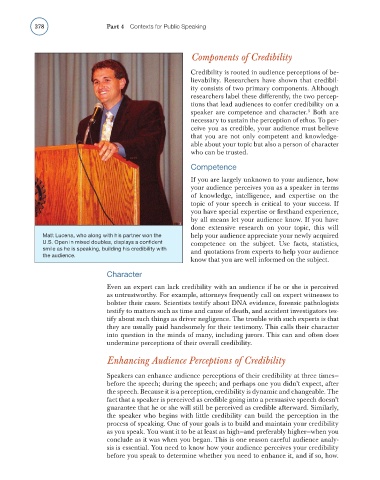
                    Matt Lucena, who along with his partner won the   help your audience appreciate your newly acquired
                    U.S. Open in mixed doubles, displays a confi dent   competence on the subject. Use facts, statistics,
                    smile as he is speaking, building his credibility with   and quotations from experts to help your audience
                    the audience.
                                                                 know that you are well informed on the subject.

                                        Character
                                        Even an expert can lack credibility with an audience if he or she is perceived
                                        as untrustworthy. For example, attorneys frequently call on expert witnesses to
                                        bolster their cases. Scientists testify about DNA evidence, forensic pathologists
                                        testify to matters such as time and cause of death, and accident investigators tes-
                                        tify about such things as driver negligence. The trouble with such experts is that
                                        they are usually paid handsomely for their testimony. This calls their character
                                        into question in the minds of many, including jurors. This can and often does
                                        undermine perceptions of their overall credibility.

                                        Enhancing Audience Perceptions of Credibility

                                        Speakers can enhance audience perceptions of their credibility at three times—
                                        before the speech; during the speech; and perhaps one you didn’t expect, after
                                        the speech. Because it is a perception, credibility is dynamic and changeable. The
                                        fact that a speaker is perceived as credible going into a persuasive speech doesn’t
                                        guarantee that he or she will still be perceived as credible afterward. Similarly,
                                        the speaker who begins with little credibility can build the perception in the
                                        process of speaking. One of your goals is to build and maintain your credibility
                                        as you speak. You want it to be at least as high—and preferably higher—when you
                                        conclude as it was when you began. This is one reason careful audience analy-
                                        sis is essential. You need to know how your audience perceives your credibility
                                        before you speak to determine whether you need to enhance it, and if so, how.

