


Page 334 - Beyond Decommissioning
P. 334
310                                                Beyond Decommissioning

            Fernald’s future land use includes natural resource restoration on most of the site.
         This approach was a part of the negotiations to settle the state of Ohio’s environmental
         damage claims against DOE. Restoration includes the development of wetlands, for-
         ests, and prairie areas. Low-impact public access is allowed. The On-Site Disposal
         Facility will remain and will be constantly monitored (Interstate Technology and
         Regulatory Council, 2002). These goals are described in more detail as follows.
            The redevelopment plan for Fernald includes nearly 160ha of woodland, over
         130ha of prairie, over 56ha of open water and native wetlands, and 13ha of savannah
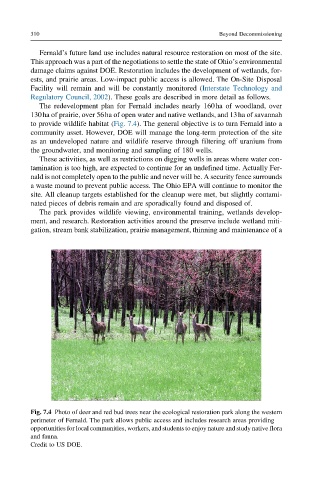
         to provide wildlife habitat (Fig. 7.4). The general objective is to turn Fernald into a
         community asset. However, DOE will manage the long-term protection of the site
         as an undeveloped nature and wildlife reserve through filtering off uranium from
         the groundwater, and monitoring and sampling of 180 wells.
            These activities, as well as restrictions on digging wells in areas where water con-
         tamination is too high, are expected to continue for an undefined time. Actually Fer-
         nald is not completely open to the public and never will be. A security fence surrounds
         a waste mound to prevent public access. The Ohio EPA will continue to monitor the
         site. All cleanup targets established for the cleanup were met, but slightly contami-
         nated pieces of debris remain and are sporadically found and disposed of.
            The park provides wildlife viewing, environmental training, wetlands develop-
         ment, and research. Restoration activities around the preserve include wetland miti-
         gation, stream bank stabilization, prairie management, thinning and maintenance of a


         Fig. 7.4 Photo of deer and red bud trees near the ecological restoration park along the western
         perimeter of Fernald. The park allows public access and includes research areas providing
         opportunities for local communities, workers, and students to enjoy nature and study native flora
         and fauna.
         Credit to US DOE.

