


Page 337 - Beyond Decommissioning
P. 337
Case studies of nuclear redevelopment                             313

           undeveloped forested woodland and not contaminated by plant operations, the conclu-
           sion was reached that it should be easy to transfer most of the property for preservation
           or economic development purposes. But planning issues became more difficult soon
           arising some questions, for example:
           l  Should the property be transferred as a single block or should it be separated into two or more
              blocks? The logical subdivision appeared to be three blocks: the undeveloped property
              which could be shortly available for disposition; the property to be reclaimed from the for-
              mer power plant footprint which would be available for disposition until after the
              decommissioning/remediation was substantially completed; and the smaller area where
              the independent spent fuel storage installation (ISFSI) was installed and expected to remain
              for many years.
           l  How difficult would it be to transfer some of the property soon and wait many years for the
              ISFSI parcel to be transferred upon removal of the spent fuel?
           l  How would ongoing regulatory requirements (e.g., environmental monitoring or for the
              ISFSI security) be fulfilled if the property had been transferred in whole or in part before
              the requirements terminated?
              What are the financial terms of property transfer?
           l
              Should the YNPS impose any restrictions on future uses of the property? Or would any such
           l
              restrictions expected to be imposed by other parties (e.g., the NRC or Massachusetts)?
           During the planning review, it transpired that the parties were quite unfamiliar with
           legal and financial aspects of property transfer in this relatively new case. This
           required a significant time for clarification.
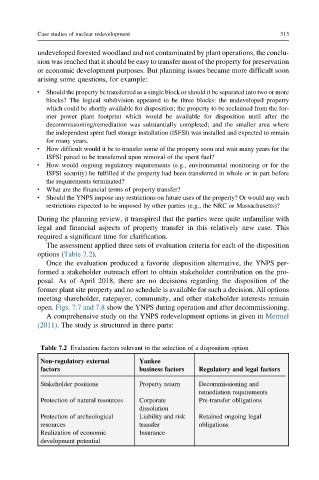
              The assessment applied three sets of evaluation criteria for each of the disposition
           options (Table 7.2).
              Once the evaluation produced a favorite disposition alternative, the YNPS per-
           formed a stakeholder outreach effort to obtain stakeholder contribution on the pro-
           posal. As of April 2018, there are no decisions regarding the disposition of the
           former plant site property and no schedule is available for such a decision. All options
           meeting shareholder, ratepayer, community, and other stakeholder interests remain
           open. Figs. 7.7 and 7.8 show the YNPS during operation and after decommissioning.
              A comprehensive study on the YNPS redevelopment options in given in Mermel
           (2011). The study is structured in three parts:


            Table 7.2 Evaluation factors relevant to the selection of a disposition option
            Non-regulatory external    Yankee
            factors                    business factors  Regulatory and legal factors
            Stakeholder positions      Property return  Decommissioning and
                                                       remediation requirements
            Protection of natural resources  Corporate  Pre-transfer obligations
                                       dissolution
            Protection of archeological  Liability and risk  Retained ongoing legal
            resources                  transfer        obligations
            Realization of economic    Insurance
            development potential

