


Page 184 - Biobehavioral Resilence to Stress
P. 184
Resilience and Survival in Extreme Environments                 161


                                 Nucleus accumbens


                             Prefrontal cortex
                                             Galanin
                                                                      Corticotropin-
                                                  Norepinephrine
                                                   Dopamine            releasing
                                                                       hormone
                                                         Hypothalamus
                                                                                Amygdala
                                                        Neuropeptide Y
                                                              Galanin

                                           Cortisol                             Corticotropin-
                                                                                 releasing
                                              Cortisol   Hippocampus             hormone

                                Adrenal gland                  Ventral
                                                              tegmental            Locus coeruleus
                                                                area
                                                                                  Galanin
                                                                  Neuropeptide Y
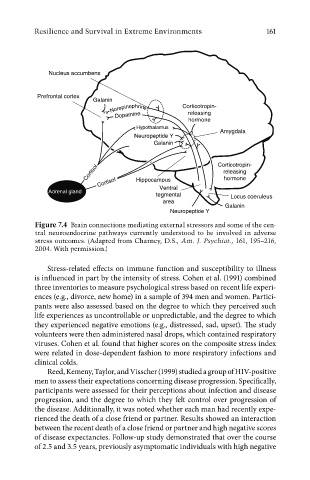
                             Figure 7.4  Brain connections mediating external stressors and some of the cen-
                             tral neuroendocrine pathways currently understood to be involved in adverse
                             stress outcomes. (Adapted from Charney, D.S., Am. J. Psychiat., 161, 195–216,
                             2004. With permission.)


                                Stress-related effects on immune function and susceptibility to illness

                             is infl uenced in part by the intensity of stress. Cohen et al. (1991) combined
                             three inventories to measure psychological stress based on recent life experi-
                             ences (e.g., divorce, new home) in a sample of 394 men and women. Partici-
                             pants were also assessed based on the degree to which they perceived such
                             life experiences as uncontrollable or unpredictable, and the degree to which
                             they experienced negative emotions (e.g., distressed, sad, upset). Th e study
                             volunteers were then administered nasal drops, which contained respiratory
                             viruses. Cohen et al. found that higher scores on the composite stress index
                             were related in dose-dependent fashion to more respiratory infections and
                             clinical colds.
                                Reed, Kemeny, Taylor, and Visscher (1999) studied a group of HIV- positive
                             men to assess their expectations concerning disease progression. Specifi cally,
                             participants were assessed for their perceptions about infection and disease
                             progression, and the degree to which they felt control over progression of
                             the disease. Additionally, it was noted whether each man had recently expe-
                             rienced the death of a close friend or partner. Results showed an interaction
                             between the recent death of a close friend or partner and high negative scores
                             of disease expectancies. Follow-up study demonstrated that over the course
                             of 2.5 and 3.5 years, previously asymptomatic individuals with high negative


                                                                                             12/15/2007   3:33:09 PM
                    CRC_71777_Ch007.indd   161                                               12/15/2007   3:33:09 PM
                    CRC_71777_Ch007.indd   161

