


Page 220 - Biobehavioral Resilence to Stress
P. 220
Posttraumatic Stress Disorder                                   197

                             Table 8.1  Single Nucleotide Polymorphism Characteristics of Candidate
                             Genes for PTSD
                                                             Size   Total  Trans      ns
                             Label     Gene Name     Chrom (bases)  SNPs  Fac  Splice cSNPs  Intron
                             CRH    Corticotropin      8q13  2,214   7    1     5     1      0
                                    releasing hormone
                             CRHR1 Corticotropin      17q12  51,524  115  1     1     0     63
                                    releasing hormone
                                    receptor 1
                             CRHR2 Corticotropin       7p14  47,519  131  0     6     5     46
                                    releasing hormone
                                    receptor 2
                             TH     Tyrosine hydroxylase  11p15  7,875  99  1   1     0     52
                             HTT    Serotonin transporter  17q11  37,799  38  0  3    1     11
                             Key:   Label: gene label; chrom: chromosomal position; size: size of the gene in bases; total
                                 SNPs: total number of SNPs in public domain databases associated with the gene; trans
                                 fac: SNPs known to be within a transcription factor binding site; splice: SNPs in genic
                                 positions likely to eff ect splicing; ns cSNPs: nonsynonymous amino acid substitutions;
                                 intron: SNPs in intronic positions.


                             Bioinformatically Informed Candidate Gene Studies
                             Rather than contend with the costs and challenges inherent to genome-wide
                             association studies, researchers may opt to conduct investigations that tar-

                             get specific candidate genes or genetic variations. Increasingly sophisticated
                             genetic databases and information resources can help researchers to over-


                             come difficulties associated with the identification of candidate genes. For

                             example, there now exists a very large body of publicly accessible informa-
                             tion about gene expression patterns (see http://ntddb.abcc.ncifcrf.gov/cgi-
                             bin/nltissue.pl), the interaction of genes and proteins at the molecular level
                             (see http://www.hpid.org/), and the effects of gene silencing and gene knock-

                             outs* in model organisms (Austin et al., 2004). Other databases contain very
                             detailed information about actual gene variations and their likely functional

                             or physiological signifi cance. This information can also be obtained from
                             computational (or  in silico) studies such as those that address the three-
                             dimensional structure of an encoded protein, gene transcription factors, or
                             protein interactions with other proteins or molecules.

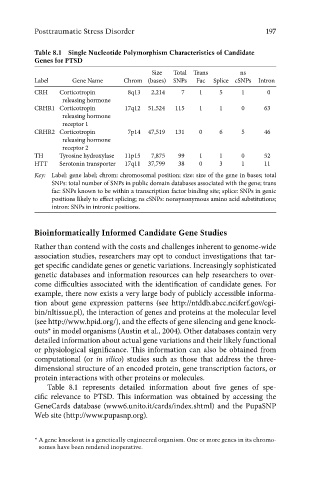
                                Table 8.1 represents detailed information about five genes of spe-
                             cific relevance to PTSD. This information was obtained by accessing the


                             GeneCards database (www6.unito.it/cards/index.shtml) and the PupaSNP
                             Web site (http://www.pupasnp.org).


                             * A gene knockout is a genetically engineered organism. One or more genes in its chromo-
                              somes have been rendered inoperative.


                                                                                             1/22/2008   9:36:20 PM
                    CRC_71777_Ch008.indd   197
                    CRC_71777_Ch008.indd   197                                               1/22/2008   9:36:20 PM

