


Page 406 - Biomimetics : Biologically Inspired Technologies
P. 406
Bar-Cohen : Biomimetics: Biologically Inspired Technologies DK3163_c015 Final Proof page 392 6.9.2005 12:43pm


                    392                                     Biomimetics: Biologically Inspired Technologies


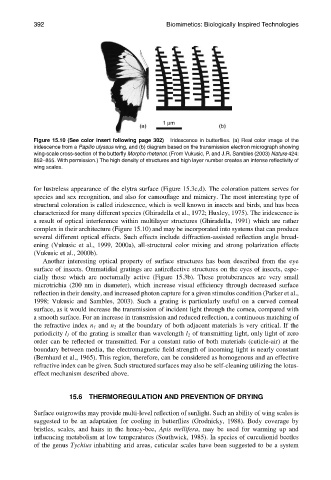
                    Figure 15.10 (See color insert following page 302)  Iridescence in butterflies. (a) Real color image of the
                    iridescence from a Papilio ulyssus wing, and (b) diagram based on the transmission electron micrograph showing
                    wing-scale cross-section of the butterfly Morpho rhetenor. (From Vukusic, P. and J.R. Sambles (2003) Nature 424:
                    852–855. With permission.) The high density of structures and high layer number creates an intense reflectivity of
                    wing scales.


                    for lustreless appearance of the elytra surface (Figure 15.3c,d). The coloration pattern serves for
                    species and sex recognition, and also for camouflage and mimicry. The most interesting type of
                    structural coloration is called iridescence, which is well known in insects and birds, and has been
                    characterized for many different species (Ghiradella et al., 1972; Huxley, 1975). The iridescence is
                    a result of optical interference within multilayer structures (Ghiradella, 1991) which are rather
                    complex in their architecture (Figure 15.10) and may be incorporated into systems that can produce
                    several different optical effects. Such effects include diffraction-assisted reflection angle broad-
                    ening (Vukusic et al., 1999, 2000a), all-structural color mixing and strong polarization effects
                    (Vukusic et al., 2000b).
                       Another interesting optical property of surface structures has been described from the eye
                    surface of insects. Ommatidial gratings are antireflective structures on the eyes of insects, espe-
                    cially those which are nocturnally active (Figure 15.3b). These protuberances are very small
                    microtrichia (200 nm in diameter), which increase visual efficiency through decreased surface
                    reflection in their density, and increased photon capture for a given stimulus condition (Parker et al.,
                    1998; Vukusic and Sambles, 2003). Such a grating is particularly useful on a curved corneal
                    surface, as it would increase the transmission of incident light through the cornea, compared with
                    a smooth surface. For an increase in transmission and reduced reflection, a continuous matching of
                    the refractive index n 1 and n 2 at the boundary of both adjacent materials is very critical. If the
                    periodicity l 1 of the grating is smaller than wavelength l 2 of transmitting light, only light of zero
                    order can be reflected or transmitted. For a constant ratio of both materials (cuticle-air) at the
                    boundary between media, the electromagnetic field strength of incoming light is nearly constant
                    (Bernhard et al., 1965). This region, therefore, can be considered as homogenous and an effective
                    refractive index can be given. Such structured surfaces may also be self-cleaning utilizing the lotus-
                    effect mechanism described above.


                               15.6  THERMOREGULATION AND PREVENTION OF DRYING

                    Surface outgrowths may provide multi-level reflection of sunlight. Such an ability of wing scales is
                    suggested to be an adaptation for cooling in butterflies (Grodnicky, 1988). Body coverage by
                    bristles, scales, and hairs in the honey-bee, Apis mellifera, may be used for warming up and
                    influencing metabolism at low temperatures (Southwick, 1985). In species of curculionid beetles
                    of the genus Tychius inhabiting arid areas, cuticular scales have been suggested to be a system

