


Page 103 - Biorefinery 2030
P. 103
2  Different Aspects of Industrial Symbiosis at the Bazancourt-Pomacle Biorefinery  71

            2.1    The Bazancourt-Pomacle Biorefinery and Its Local
                   Environment

            The industrial symbiosis operating at the Bazancourt-Pomacle biorefinery is the
            fruit of long-term, complex interactions between the site’s different economic
            actors and those in the surrounding area.
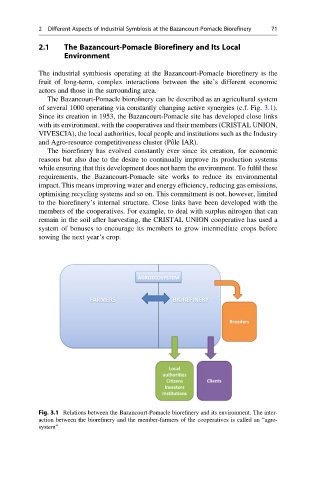
              The Bazancourt-Pomacle biorefinery can be described as an agricultural system
            of several 1000 operating via constantly changing active synergies (c.f. Fig. 3.1).
            Since its creation in 1953, the Bazancourt-Pomacle site has developed close links
            with its environment, with the cooperatives and their members (CRISTAL UNION,
            VIVESCIA), the local authorities, local people and institutions such as the Industry
            and Agro-resource competitiveness cluster (Po ˆle IAR).
              The biorefinery has evolved constantly ever since its creation, for economic
            reasons but also due to the desire to continually improve its production systems
            while ensuring that this development does not harm the environment. To fulfil these
            requirements, the Bazancourt-Pomacle site works to reduce its environmental
            impact. This means improving water and energy efficiency, reducing gas emissions,
            optimising recycling systems and so on. This commitment is not, however, limited
            to the biorefinery’s internal structure. Close links have been developed with the
            members of the cooperatives. For example, to deal with surplus nitrogen that can
            remain in the soil after harvesting, the CRISTAL UNION cooperative has used a
            system of bonuses to encourage its members to grow intermediate crops before
            sowing the next year’s crop.


            Fig. 3.1 Relations between the Bazancourt-Pomacle biorefinery and its environment. The inter-
            action between the biorefinery and the member-farmers of the cooperatives is called an “agro-
            system”

