


Page 309 - Buried Pipe Design
P. 309
280   Chapter Five

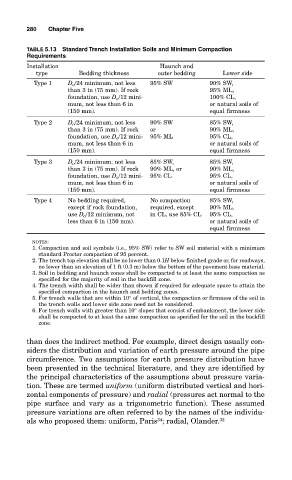
         TABLE 5.13 Standard Trench Installation Soils and Minimum Compaction
         Requirements
         Installation                         Haunch and
            type        Bedding thickness    outer bedding     Lower side
           Type 1    D o /24 minimum, not less   95% SW    90% SW,
                     than 3 in (75 mm). If rock            95% ML,
                     foundation, use D o /12 mini-         100% CL,
                     mum, not less than 6 in               or natural soils of
                     (150 mm).                             equal firmness
           Type 2    D o /24 minimum, not less   90% SW    85% SW,
                     than 3 in (75 mm). If rock   or       90% ML,
                     foundation, use D o /12 mini-  95% ML  95% CL,
                     mum, not less than 6 in               or natural soils of
                     (150 mm).                             equal firmness
           Type 3    D o /24 minimum, not less   85% SW,   85% SW,
                     than 3 in (75 mm). If rock   90% ML, or  90% ML,
                     foundation, use D o /12 mini-  95% CL  95% CL,
                     mum, not less than 6 in               or natural soils of
                     (150 mm).                             equal firmness
           Type 4    No bedding required,   No compaction   85% SW,
                     except if rock foundation,   required, except   90% ML,
                     use D o /12 minimum, not  in CL, use 85% CL  95% CL,
                     less than 6 in (150 mm).              or natural soils of
                                                           equal firmness
           NOTES:
           1. Compaction and soil symbols (i.e., 95% SW) refer to SW soil material with a minimum
             standard Proctor compaction of 95 percent.
           2. The trench top elevation shall be no lower than 0.1H below finished grade or, for roadways,
             no lower than an elevation of 1 ft (0.3 m) below the bottom of the pavement base material.
           3. Soil in bedding and haunch zones shall be compacted to at least the same compaction as
             specified for the majority of soil in the backfill zone.
           4. The trench width shall be wider than shown if required for adequate space to attain the
             specified compaction in the haunch and bedding zones.
           5. For trench walls that are within 10° of vertical, the compaction or firmness of the soil in
             the trench walls and lower side zone need not be considered.
           6. For trench walls with greater than 10° slopes that consist of embankment, the lower side
             shall be compacted to at least the same compaction as specified for the soil in the backfill
             zone.

         than does the indirect method. For example, direct design usually con-
         siders the distribution and variation of earth pressure around the pipe
         circumference. Two assumptions for earth pressure distribution have
         been presented in the technical literature, and they are identified by
         the principal characteristics of the assumptions about pressure varia-
         tion. These are termed uniform (uniform distributed vertical and hori-
         zontal components of pressure) and radial (pressures act normal to the
         pipe surface and vary as a trigonometric function). These assumed
         pressure variations are often referred to by the names of the individu-
                                             34
         als who proposed them: uniform, Paris ; radial, Olander. 32

