


Page 122 -
P. 122
Chapter 3  •  Data Warehousing  121


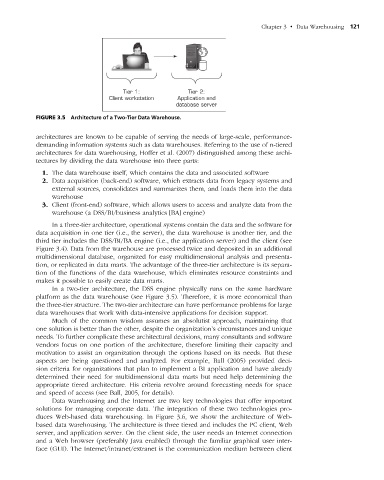
                                              Tier 1:            Tier 2:
                                          Client workstation  Application and
                                                              database server
                    figure 3.5  Architecture of a Two-Tier Data Warehouse.


                    architectures are known to be capable of serving the needs of large-scale, performance-
                    demanding information systems such as data warehouses. Referring to the use of n-tiered
                    architectures for data warehousing, Hoffer et al. (2007) distinguished among these archi-
                    tectures by dividing the data warehouse into three parts:

                      1.  The data warehouse itself, which contains the data and associated software
                      2.  Data acquisition (back-end) software, which extracts data from legacy systems and
                        external sources, consolidates and summarizes them, and loads them into the data
                        warehouse
                      3.  Client (front-end) software, which allows users to access and analyze data from the
                        warehouse (a DSS/BI/business analytics [BA] engine)
                        In a three-tier architecture, operational systems contain the data and the software for
                    data acquisition in one tier (i.e., the server), the data warehouse is another tier, and the
                    third tier includes the DSS/BI/BA engine (i.e., the application server) and the client (see
                    Figure 3.4). Data from the warehouse are processed twice and deposited in an additional
                    multidimensional database, organized for easy multidimensional analysis and presenta-
                    tion, or replicated in data marts. The advantage of the three-tier architecture is its separa-
                    tion of the functions of the data warehouse, which eliminates resource constraints and
                    makes it possible to easily create data marts.
                        In a two-tier architecture, the DSS engine physically runs on the same hardware
                    platform as the data warehouse (see Figure 3.5). Therefore, it is more economical than
                    the three-tier structure. The two-tier architecture can have performance problems for large
                    data warehouses that work with data-intensive applications for decision support.
                        Much of the common wisdom assumes an absolutist approach, maintaining that
                    one solution is better than the other, despite the organization’s circumstances and unique
                    needs. To further complicate these architectural decisions, many consultants and software
                    vendors focus on one portion of the architecture, therefore limiting their capacity and
                    motivation to assist an organization through the options based on its needs. But these
                    aspects are being questioned and analyzed. For example, Ball (2005) provided deci-
                    sion criteria for organizations that plan to implement a BI application and have already
                    determined their need for multidimensional data marts but need help determining the
                    appropriate tiered architecture. His criteria revolve around forecasting needs for space
                    and speed of access (see Ball, 2005, for details).
                        Data warehousing and the Internet are two key technologies that offer important
                    solutions for managing corporate data. The integration of these two technologies pro-
                    duces Web-based data warehousing. In Figure 3.6, we show the architecture of Web-
                    based data warehousing. The architecture is three tiered and includes the PC client, Web
                    server, and application server. On the client side, the user needs an Internet connection
                    and a Web browser (preferably Java enabled) through the familiar graphical user inter-
                    face (GUI). The Internet/intranet/extranet is the communication medium between client


           M03_SHAR9209_10_PIE_C03.indd   121                                                                     1/25/14   7:35 AM

