


Page 206 -
P. 206
Chapter 4  •  Business Reporting, Visual Analytics, and Business Performance Management   205


                                  Strategy Map:    Balanced Scorecard:    Strategic Initiatives:
                                 Linked Objectives  Measures and Targets     Action Plans


                       Financial   Increase Net   Net income   Increase
                                     Income         growth      25%


                                     Increase
                                                                            Change licensing
                                                  Maintenance
                       Customer     Customer     retention rate  Increase  and maintenance contracts
                                                                15%
                                    Retention
                                   Improve Call      Issue
                                                                             Standardized
                        Process      Center       turnaround   Improve    call center processes
                                                                30%
                                   Performance       time
                       Learning      Reduce        Voluntary   Reduce         Salary and
                         and        Employee       turnover     25%          bonus upgrade
                        Growth       Turnover        rate


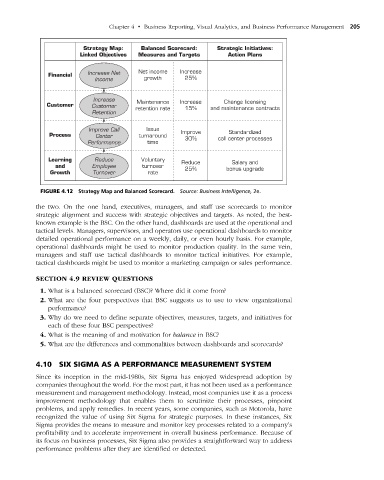
                     figuRe 4.12  Strategy Map and Balanced Scorecard.  Source: Business Intelligence, 2e.

                    the  two. On  the one  hand,  executives, managers, and  staff  use  scorecards  to monitor
                      strategic alignment and success with strategic objectives and targets. As noted, the best-
                    known example is the BSC. On the other hand, dashboards are used at the operational and
                    tactical levels. Managers, supervisors, and operators use operational dashboards to monitor
                    detailed operational performance on a weekly, daily, or even hourly basis. For example,
                    operational dashboards might be used to monitor production quality. In the same vein,
                    managers and staff use tactical dashboards to monitor tactical initiatives. For example,
                    tactical dashboards might be used to monitor a marketing campaign or sales performance.
                    sectiOn 4.9 revieW QuestiOns

                      1. What is a balanced scorecard (BSC)? Where did it come from?
                      2. What are the four perspectives that BSC suggests us to use to view organizational
                       performance?
                      3. Why do we need to define separate objectives, measures, targets, and initiatives for
                       each of these four BSC perspectives?
                      4. What is the meaning of and motivation for balance in BSC?
                      5. What are the differences and commonalities between dashboards and scorecards?

                    4.10  six sigMA As A peRfoRMAnCe MeAsuReMent systeM

                    Since its inception in the mid-1980s, Six Sigma has enjoyed widespread adoption by
                      companies throughout the world. For the most part, it has not been used as a  performance
                    measurement and management methodology. Instead, most companies use it as a  process
                    improvement  methodology  that  enables  them  to  scrutinize  their  processes,  pinpoint
                      problems, and apply remedies. In recent years, some companies, such as Motorola, have
                    recognized the value of using Six Sigma for strategic purposes. In these instances, Six
                    Sigma provides the means to measure and monitor key processes related to a company’s
                    profitability and to accelerate improvement in overall business performance. Because of
                    its focus on business processes, Six Sigma also provides a straightforward way to address
                    performance problems after they are identified or detected.


           M04_SHAR9209_10_PIE_C04.indd   205                                                                     1/25/14   7:34 AM

