


Page 151 - Calculus Demystified
P. 151
138     EXAMPLE 5.19         CHAPTER 5         Indeterminate Forms
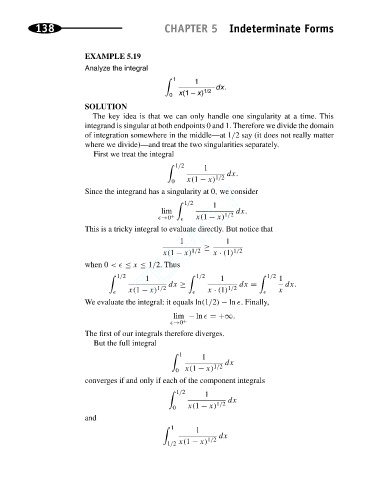
                                   Analyze the integral
                                                           1    1
                                                          0  x(1 − x) 1/2  dx.

                                   SOLUTION
                                     The key idea is that we can only handle one singularity at a time. This
                                   integrand is singular at both endpoints 0 and 1. Therefore we divide the domain
                                   of integration somewhere in the middle—at 1/2 say (it does not really matter
                                   where we divide)—and treat the two singularities separately.
                                     First we treat the integral
                                                            1/2
                                                                   1  1/2  dx.
                                                          0   x(1 − x)
                                   Since the integrand has a singularity at 0, we consider
                                                               1/2   1   1/2Y
                                                       lim
                                                       (→0 +     x(1 − x)   dx.
                                                             (
                                   This is a tricky integral to evaluate directly. But notice that
                                                            1
                                                    TEAMFL               1
                                                                   ≥
                                                        x(1 − x) 1/2  x · (1) 1/2
                                   when 0 <( ≤ x ≤ 1/2. Thus
                                            1/2    1              1/2  1             1/2  1
                                               x(1 − x) 1/2  dx ≥   x · (1) 1/2  dx =  x  dx.
                                          (                     (                  (
                                   We evaluate the integral: it equals ln(1/2) − ln (. Finally,
                                                           lim − ln ( =+∞.
                                                          (→0 +
                                   The first of our integrals therefore diverges.
                                     But the full integral
                                                             1    1
                                                           0 x(1 − x) 1/2  dx
                                   converges if and only if each of the component integrals

                                                            1/2
                                                                   1     dx
                                                           0   x(1 − x) 1/2
                                   and
                                                           1     1
                                                         1/2 x(1 − x) 1/2  dx


                                                                  ®
                                                         Team-Fly

