


Page 251 - Calculus Workbook For Dummies
P. 251
235
                                   Chapter 12: Who Needs Freud? Using the Integral to Solve Your Problems


                                                                               1
                                                    3
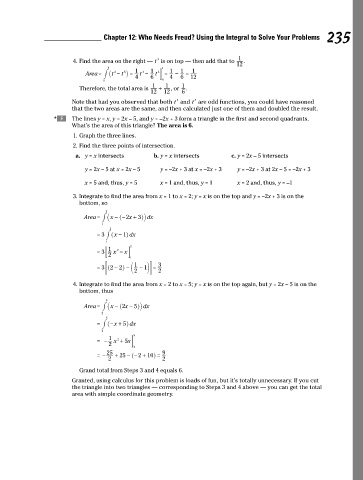
                         4. Find the area on the right — t is on top — then add that to   .
                                                                              12
                                    1                 1
                                                4
                                                     6
                                          5
                                      3
                             Area= # _ t -  t i  =  1  t -  1  t E  =  1  -  1  =  1
                                             4    6     4   6  12
                                   0                  0
                                                   1   1    1
                           Therefore, the total area is   +  , or  .
                                                  12   12   6
                                                                 5
                                                           3
                         Note that had you observed that both t and t are odd functions, you could have reasoned
                         that the two areas are the same, and then calculated just one of them and doubled the result.
                   *e    The lines y = x, y = 2x – 5, and y = –2x + 3 form a triangle in the first and second quadrants.
                         What’s the area of this triangle? The area is 6.
                         1. Graph the three lines.
                         2. Find the three points of intersection.
                          a. y = x intersects      b. y = x intersects       c. y = 2x – 5 intersects
                             y = 2x – 5 at x = 2x – 5  y = –2x + 3 at x = –2x + 3  y = –2x + 3 at 2x – 5 = –2x + 3
                             x = 5 and, thus, y = 5  x = 1 and, thus, y = 1    x = 2 and, thus, y = –1

                         3. Integrate to find the area from x = 1 to x = 2; y = x is on the top and y = –2x + 3 is on the
                           bottom, so
                                    2
                                        ^
                            Area= # ` x - - 2 x +  3hj dx
                                  1
                                     2
                                 =  3 #^  x -  1h  dx
                                   1
                                            2
                                    1  2
                                          x
                                 =  3 ;  x - E
                                    2
                                            1
                                             1       3
                                                1 =
                                  3 2 - h
                                 = = ^  2 - c  - mG
                                             2       2
                         4. Integrate to find the area from x = 2 to x = 5; y = x is on the top again, but y = 2x – 5 is on the
                           bottom, thus
                                    5
                            Area= # `  x - ^ 2 x -  5hj  dx
                                  2
                                    5
                                 = #^ - x +  5h  dx
                                  2
                                             5
                                     1
                                       2
                                 = -  x +  5 xE
                                     2
                                             2
                                    25                9
                                 = -   +  25 - - +  10 =
                                              2
                                                   h
                                            ^
                                    2                 2
                           Grand total from Steps 3 and 4 equals 6.
                         Granted, using calculus for this problem is loads of fun, but it’s totally unnecessary. If you cut
                         the triangle into two triangles — corresponding to Steps 3 and 4 above — you can get the total
                         area with simple coordinate geometry.

