


Page 337 - Cam Design Handbook
P. 337
THB11  9/19/03  7:33 PM  Page 325

                                    CAM SYSTEM MODELING                    325

            tial frame while the body moves. In this case, the velocity at any point p on the body can
            be given by
                                         v = w  ¥  r                     (11.18)
                                          p      0
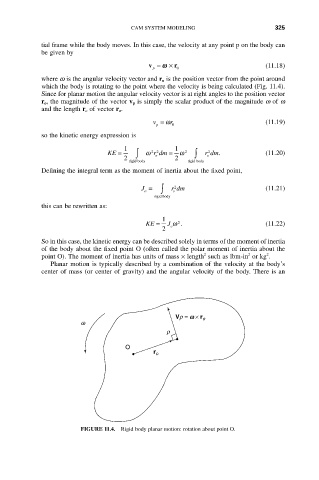
            where w is the angular velocity vector and r o is the position vector from the point around
            which the body is rotating to the point where the velocity is being calculated (Fig. 11.4).
            Since for planar motion the angular velocity vector is at right angles to the position vector
            r o , the magnitude of the vector v p is simply the scalar product of the magnitude w of w
            and the length r o of vector r o .
                                          v = w r 0                      (11.19)
                                           p
            so the kinetic energy expression is

                                   1            1
                              KE =    Ú  w  2 r dm =  w  2  Ú  r dm.     (11.20)
                                           2
                                                         2
                                   2       o    2        o
                                    rigid body      rigid body
            Defining the integral term as the moment of inertia about the fixed point,
                                       J =  Ú  r dm                      (11.21)
                                                2
                                        o       o
                                           rigid body
            this can be rewritten as:
                                             1
                                                 2
                                        KE =  J w .                      (11.22)
                                               o
                                             2
            So in this case, the kinetic energy can be described solely in terms of the moment of inertia
            of the body about the fixed point O (often called the polar moment of inertia about the
                                                        2
                                                                    2
                                                                         2
            point O). The moment of inertia has units of mass ¥ length such as lbm-in or kg .
               Planar motion is typically described by a combination of the velocity at the body’s
            center of mass (or center of gravity) and the angular velocity of the body. There is an


                                                Vr = w ¥ r o
                       w
                                              r
                                   O
                                          r o


                       FIGURE 11.4.  Rigid body planar motion: rotation about point O.

