


Page 293 - Carbonate Platforms Facies, Sequences, and Evolution
P. 293
to
274
stage.
of the
The
the
episodes
ent facies
and flysch
terrigenous
same break
of
region
transgressions
characteristics
Aptian
origins of these.
(Fig.
to
of the
influx
Urgonian
and
and
a
of four main cycles,
18).
limestone
the subdivision of the
from
the
cycles
sedimentation.
great
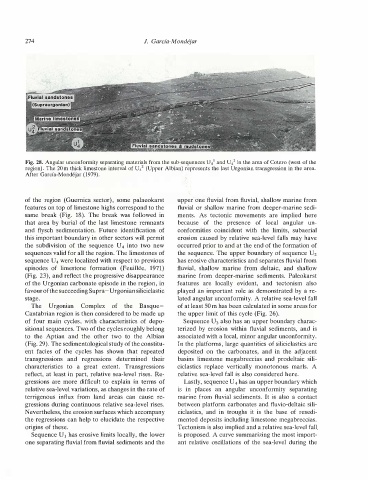
After Garcia-Mondejar (1979).
The
has
Complex
land
other
gressions are more difficult to
regressions
(Guernica sector),
sequence
favour of the succeeding Supra-U
formation
Future
of
extent.
two
areas
shown
to
the
can
with characteristics
that
the
(Feuillee,
determined
J.
reflect, at least in part, relative sea-level rises.
cause
identification
Basque
of depo
Re
(Fig. 29). The sedimentological study of the constitu
re
break was followed in
features on top of limestone highs correspond to the
U4 into two new
gressions during continuous relative sea-level rises.
one separating fluvial from fluvial sediments and the
sitional sequences. Two of the cycles roughly belong
Albian
the regressions can help to elucidate the respective
Nevertheless, the erosion surfaces which accompany
their
Cantabrian region is then considered to be made up
1971)
this important boundary in other sectors will permit
of
(Fig. 23), and reflect the progressive disappearance
Sequence U1 has erosive limits locally, the lower
sequence U4 were localized with respect to previous
repeated
that area by burial of the last limestone remnants
sequences valid for all the region. The limestones of
rgonian siliciclastic
Transgressions
of the Urgonian carbonate episode in the region, in
some palaeokarst
explain in terms of
relative sea-level variations, as changes in the rate of
is
in
basins
ments.
fluvial,
Garda-Mondejar
features
because
ciclastics
ciclastics,
deposited
terized by
As
of
conformities
are
places
marine from
and
shallow
an
the
limestone
replace
on the
locally
marine
coincident
angular
erosion within
in troughs
presence
vertically
deeper-marine
from
with
evident,
carbonates,
of
marine from fluvial sediments.
megabreccias
tectonic movements
fluvial
the
and
it is the
and
are
local
the upper limit of this cycle (Fig. 26).
in
deltaic,
sediments.
unconformity
base
monotonous
limits,
the
and
sediments,
relative sea-level fall is also considered here.
implied
tectonism
angular
marls.
un
fluvial or shallow marine from deeper-marine sedi
Sequence U3 also has an upper boundary charac
and prodeltaic sili
between platform carbonates and fluvio-deltaic sili
played an important role as demonstrated by a re
is proposed. A curve summarizing the most import
region). The 20 m thick limestone interval of Ui (Upper Albian) represents the last Urgonian transgression in the area.
of resedi
A
associated with a local, minor angular unconformity.
the sequence. The upper boundary of sequence U2
has erosive characteristics and separates fluvial from
also
upper· cine fluvial from fluvial, shallow marine from
Fig. 28. Angular unconformity separating materials from the sub-sequences U41 and Ui in the area of Cotero (west of the
mented deposits including limestone megabreccias.
adjacent
ant relative oscillations of the sea-level during the
here
subaerial
lated angular unconformity. A relative sea-level fall
It is also a contact
shallow
Paleokarst
erosion caused by relative sea-level falls may have
of at least 50 m has been calculated in some areas for
Lastly, sequence U4 has an upper boundary which
In the platforms, large quantities of siliciclastics are
separating
occurred prior to and at the end of the formation of
and is
Tectonism is also implied and a relative sea-level fall.

