


Page 217 - Chemical and process design handbook
P. 217
Speight_Part II_C  11/7/01  3:08 PM  Page 2.157


                                                 CEMENT                          2.157

                                                                            Clay


                    Limestone
                              Crusher                Dryer                 Slurry tank


                                          Cement
                                          clinker
                          Cement                                  Kiln


                                 Sodium sulfate
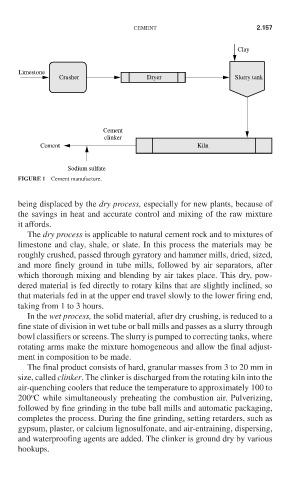
                    FIGURE 1  Cement manufacture.


                    being displaced by the dry process, especially for new plants, because of
                    the savings in heat and accurate control and mixing of the raw mixture
                    it affords.
                      The dry process is applicable to natural cement rock and to mixtures of
                    limestone and clay, shale, or slate. In this process the materials may be
                    roughly crushed, passed through gyratory and hammer mills, dried, sized,
                    and more finely ground in tube mills, followed by air separators, after
                    which thorough mixing and blending by air takes place. This dry, pow-
                    dered material is fed directly to rotary kilns that are slightly inclined, so
                    that materials fed in at the upper end travel slowly to the lower firing end,
                    taking from 1 to 3 hours.
                      In the wet process, the solid material, after dry crushing, is reduced to a
                    fine state of division in wet tube or ball mills and passes as a slurry through
                    bowl classifiers or screens. The slurry is pumped to correcting tanks, where
                    rotating arms make the mixture homogeneous and allow the final adjust-
                    ment in composition to be made.
                      The final product consists of hard, granular masses from 3 to 20 mm in
                    size, called clinker. The clinker is discharged from the rotating kiln into the
                    air-quenching coolers that reduce the temperature to approximately 100 to
                       o
                    200 C while simultaneously preheating the combustion air. Pulverizing,
                    followed by fine grinding in the tube ball mills and automatic packaging,
                    completes the process. During the fine grinding, setting retarders, such as
                    gypsum, plaster, or calcium lignosulfonate, and air-entraining, dispersing,
                    and waterproofing agents are added. The clinker is ground dry by various
                    hookups.

