


Page 221 - Chemical and process design handbook
P. 221
Speight_Part II_C  11/7/01  3:08 PM  Page 2.161


                                         CHLORINE


                    Chlorine (Cl , melting point: –101°C, boiling point:–34.6°C, density (gas):
                               2
                    3.209 g/L at 0°C) is a pale greenish-yellow gas of marked odor, irritating
                    to the eyes and throat, and poisonous.
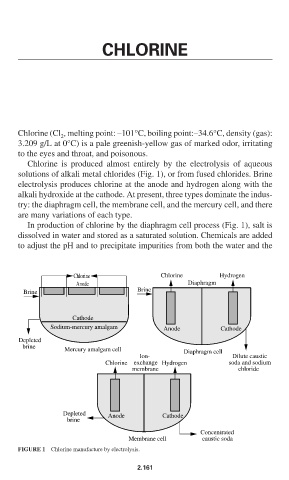
                      Chlorine is produced almost entirely by the electrolysis of aqueous
                    solutions of alkali metal chlorides (Fig. 1), or from fused chlorides. Brine
                    electrolysis produces chlorine at the anode and hydrogen along with the
                    alkali hydroxide at the cathode. At present, three types dominate the indus-
                    try: the diaphragm cell, the membrane cell, and the mercury cell, and there
                    are many variations of each type.
                      In production of chlorine by the diaphragm cell process (Fig. 1), salt is
                    dissolved in water and stored as a saturated solution. Chemicals are added
                    to adjust the pH and to precipitate impurities from both the water and the


                                  Chlorine              Chlorine       Hydrogen
                                   Anode                       Diaphragm
                     Brine                        Brine


                                  Cathode
                            Sodium-mercury amalgam       Anode          Cathode
                    Depleted
                     brine
                                Mercury amalgam cell          Diaphragm cell
                                                   Ion-                    Dilute caustic
                                          Chlorine  exchange  Hydrogen    soda and sodium
                                                 membrane                   chloride


                               Depleted    Anode         Cathode
                                brine
                                                                  Concentrated
                                                Membrane cell      caustic soda
                    FIGURE 1  Chlorine manufacture by electrolysis.

                                                  2.161

