


Page 391 - Chemical engineering design
P. 391
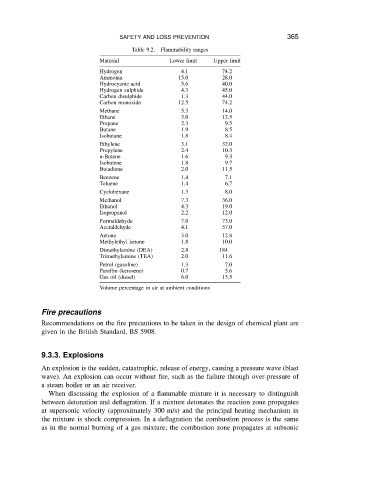
Table 9.2.
                                                      Flammability ranges
                                    Material SAFETY AND LOSS PREVENTION  Upper limit      365
                                                        Lower limit
                                    Hydrogen               4.1         74.2
                                    Ammonia                15.0        28.0
                                    Hydrocyanic acid       5.6         40.0
                                    Hydrogen sulphide      4.3         45.0
                                    Carbon disulphide      1.3         44.0
                                    Carbon monoxide        12.5        74.2
                                    Methane                5.3         14.0
                                    Ethane                 3.0         12.5
                                    Propane                2.3          9.5
                                    Butane                 1.9          8.5
                                    Isobutane              1.8          8.4
                                    Ethylene               3.1         32.0
                                    Propylene              2.4         10.3
                                    n-Butene               1.6          9.3
                                    Isobutene              1.8          9.7
                                    Butadiene              2.0         11.5
                                    Benzene                1.4          7.1
                                    Toluene                1.4          6.7
                                    Cyclohexane            1.3          8.0
                                    Methanol               7.3         36.0
                                    Ethanol                4.3         19.0
                                    Isopropanol            2.2         12.0
                                    Formaldehyde           7.0         73.0
                                    Acetaldehyde           4.1         57.0
                                    Aetone                 3.0         12.8
                                    Methylethyl ketone     1.8         10.0
                                    Dimethylamine (DEA)    2.8        184
                                    Trimethylamine (TEA)   2.0         11.6
                                    Petrol (gasoline)      1.3          7.0
                                    Paraffin (kerosene)     0.7          5.6
                                    Gas oil (diesel)       6.0         13.5
                                    Volume percentage in air at ambient conditions


                   Fire precautions
                   Recommendations on the fire precautions to be taken in the design of chemical plant are
                   given in the British Standard, BS 5908.


                   9.3.3. Explosions

                   An explosion is the sudden, catastrophic, release of energy, causing a pressure wave (blast
                   wave). An explosion can occur without fire, such as the failure through over-pressure of
                   a steam boiler or an air receiver.
                     When discussing the explosion of a flammable mixture it is necessary to distinguish
                   between detonation and deflagration. If a mixture detonates the reaction zone propagates
                   at supersonic velocity (approximately 300 m/s) and the principal heating mechanism in
                   the mixture is shock compression. In a deflagration the combustion process is the same
                   as in the normal burning of a gas mixture; the combustion zone propagates at subsonic

