


Page 396 - Chemical engineering design
P. 396
370
                                                        CHEMICAL ENGINEERING
                           of control of reactors and heaters; and, externally, from open fires. In the design of
                           processes where high temperatures are a hazard, protection against high temperatures is
                           provided by:
                             1. Provision of high-temperature alarms and interlocks to shut down reactor feeds, or
                                heating systems, if the temperature exceeds critical limits.
                             2. Provision of emergency cooling systems for reactors, where heat continues to be
                                generated after shut-down; for instance, in some polymerisation systems.
                             3. Structural design of equipment to withstand the worst possible temperature ex-
                                cursion.
                             4. The selection of intrinsically safe heating systems for hazardous materials.
                             Steam, and other vapour heating systems, are intrinsically safe; as the temperature
                           cannot exceed the saturation temperature at the supply pressure. Other heating systems
                           rely on control of the heating rate to limit the maximum process temperature. Electrical
                           heating systems can be particularly hazardous.

                           Fire protection
                           To protect against structural failure, water-deluge systems are usually installed to keep
                           vessels and structural steelwork cool in a fire.
                             The lower section of structural steel columns are also often lagged with concrete or
                           other suitable materials.


                           9.3.8. Noise
                           Excessive noise is a hazard to health and safety. Long exposure to high noise levels
                           can cause permanent damage to hearing. At lower levels, noise is a distraction and
                           causes fatigue.
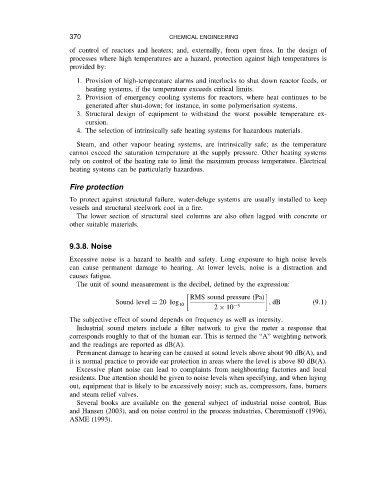
                             The unit of sound measurement is the decibel, defined by the expression:


                                                              RMS sound pressure (Pa)
                                         Sound level D 20 log                        , dB         9.1
                                                           10               5
                                                                     2 ð 10
                           The subjective effect of sound depends on frequency as well as intensity.
                             Industrial sound meters include a filter network to give the meter a response that
                           corresponds roughly to that of the human ear. This is termed the “A” weighting network
                           and the readings are reported as dB(A).
                             Permanent damage to hearing can be caused at sound levels above about 90 dB(A), and
                           it is normal practice to provide ear protection in areas where the level is above 80 dB(A).
                             Excessive plant noise can lead to complaints from neighbouring factories and local
                           residents. Due attention should be given to noise levels when specifying, and when laying
                           out, equipment that is likely to be excessively noisy; such as, compressors, fans, burners
                           and steam relief valves.
                             Several books are available on the general subject of industrial noise control, Bias
                           and Hansen (2003), and on noise control in the process industries, Cheremisnoff (1996),
                           ASME (1993).

