


Page 399 - Chemical engineering design
P. 399
SAFETY AND LOSS PREVENTION
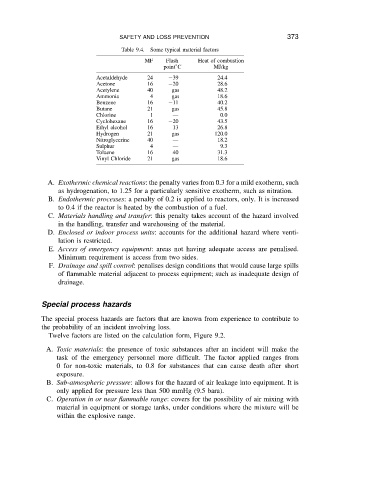
                                          Table 9.4.
                                                 MF Some typical material factors         373
                                                                Heat of combustion
                                                       Flash
                                                      point ° C      MJ/kg
                                   Acetaldehyde   24     39           24.4
                                   Acetone        16     20           28.6
                                   Acetylene      40     gas          48.2
                                   Ammonia         4     gas          18.6
                                   Benzene        16     11           40.2
                                   Butane         21     gas          45.8
                                   Chlorine        1                   0.0
                                   Cyclohexane    16     20           43.5
                                   Ethyl alcohol  16     13           26.8
                                   Hydrogen       21     gas         120.0
                                   Nitroglycerine  40                 18.2
                                   Sulphur         4                   9.3
                                   Toluene        16     40           31.3
                                   Vinyl Chloride  21    gas          18.6
                     A. Exothermic chemical reactions: the penalty varies from 0.3 for a mild exotherm, such
                        as hydrogenation, to 1.25 for a particularly sensitive exotherm, such as nitration.
                     B. Endothermic processes: a penalty of 0.2 is applied to reactors, only. It is increased
                        to 0.4 if the reactor is heated by the combustion of a fuel.
                     C. Materials handling and transfer: this penalty takes account of the hazard involved
                        in the handling, transfer and warehousing of the material.
                     D. Enclosed or indoor process units: accounts for the additional hazard where venti-
                        lation is restricted.
                     E. Access of emergency equipment: areas not having adequate access are penalised.
                        Minimum requirement is access from two sides.
                     F. Drainage and spill control: penalises design conditions that would cause large spills
                        of flammable material adjacent to process equipment; such as inadequate design of
                        drainage.


                   Special process hazards

                   The special process hazards are factors that are known from experience to contribute to
                   the probability of an incident involving loss.
                     Twelve factors are listed on the calculation form, Figure 9.2.
                     A. Toxic materials: the presence of toxic substances after an incident will make the
                        task of the emergency personnel more difficult. The factor applied ranges from
                        0 for non-toxic materials, to 0.8 for substances that can cause death after short
                        exposure.
                     B. Sub-atmospheric pressure: allows for the hazard of air leakage into equipment. It is
                        only applied for pressure less than 500 mmHg (9.5 bara).
                     C. Operation in or near flammable range: covers for the possibility of air mixing with
                        material in equipment or storage tanks, under conditions where the mixture will be
                        within the explosive range.

