


Page 398 - Chemical engineering design
P. 398
372
CHEMICAL ENGINEERING
Select Pertinent
Process Unit
Determine
Material Factor
Calculate F 1 Calculate F 2
General Process Hazards Factor Special Process Hazards Factor
Determine Process Unit Hazards
Factor F 3 = F 1 x F 2
Calculate Loss Control Determine F&EI
Credit Factor = C 1 x C 2 x C 3 F&EI = F 3 x Material Factor
Determine Area of Exposure
Determine Replacement
Value in Exposure Area
Determine Base MPPD Determine Damage Factor
Determine Actual MPPD
Determine MPDO
Determine BI
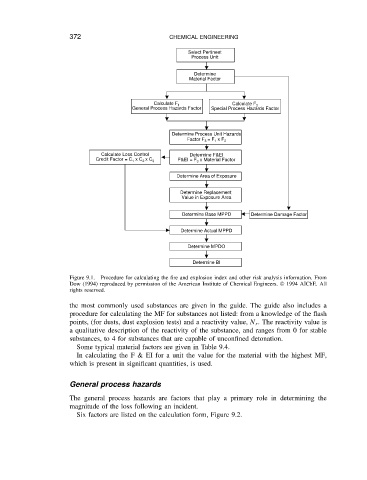
Figure 9.1. Procedure for calculating the fire and explosion index and other risk analysis information. From
Dow (1994) reproduced by permission of the American Institute of Chemical Engineers. 1994 AIChE. All
rights reserved.
the most commonly used substances are given in the guide. The guide also includes a
procedure for calculating the MF for substances not listed: from a knowledge of the flash
points, (for dusts, dust explosion tests) and a reactivity value, N r . The reactivity value is
a qualitative description of the reactivity of the substance, and ranges from 0 for stable
substances, to 4 for substances that are capable of unconfined detonation.
Some typical material factors are given in Table 9.4.
In calculating the F & EI for a unit the value for the material with the highest MF,
which is present in significant quantities, is used.
General process hazards
The general process hazards are factors that play a primary role in determining the
magnitude of the loss following an incident.
Six factors are listed on the calculation form, Figure 9.2.

