


Page 143 - Civil Engineering Formulas
P. 143
COLUMN FORMULAS                   83

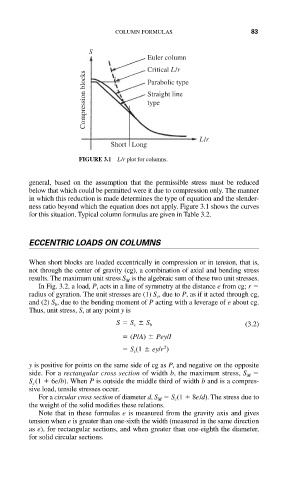
                            S
                                          Euler column
                                          Critical L/r
                           Compression blocks  Straight line
                                          Parabolic type

                                          type


                                                       L/r
                                 Short Long
                         FIGURE 3.1 L/r plot for columns.

             general, based on the assumption that the permissible stress must be reduced
             below that which could be permitted were it due to compression only. The manner
             in which this reduction is made determines the type of equation and the slender-
             ness ratio beyond which the equation does not apply. Figure 3.1 shows the curves
             for this situation. Typical column formulas are given in Table 3.2.


             ECCENTRIC LOADS ON COLUMNS

             When short blocks are loaded eccentrically in compression or in tension, that is,
             not through the center of gravity (cg), a combination of axial and bending stress
             results. The maximum unit stress S M is the algebraic sum of these two unit stresses.
               In Fig. 3.2, a load, P, acts in a line of symmetry at the distance e from cg; r
             radius of gyration. The unit stresses are (1) S c , due to P, as if it acted through cg,
             and (2) S b , due to the bending moment of P acting with a leverage of e about cg.
             Thus, unit stress, S, at any point y is

                                   S   S c   S b                   (3.2)
                                      (P/A)   Pey/I
                                               2
                                      S c (1   ey/r )
             y is positive for points on the same side of cg as P, and negative on the opposite
             side. For a rectangular cross section of width b, the maximum stress, S M
             S c (1   6e/b). When P is outside the middle third of width b and is a compres-
             sive load, tensile stresses occur.
               For a circular cross section of diameter d, S M   S c (1   8e/d). The stress due to
             the weight of the solid modifies these relations.
               Note that in these formulas e is measured from the gravity axis and gives
             tension when e is greater than one-sixth the width (measured in the same direction
             as e), for rectangular sections, and when greater than one-eighth the diameter,
             for solid circular sections.

