


Page 149 - Collision Avoidance Rules Guide
P. 149
speed in congested waters, when in an overtaking situation, or, when
                a vessel is expected to pass astern.

                Taking avoiding action in ample time
                Avoiding action must be taken if a close quarters situation is develop-
                ing and/or risk of collision exists. It is not necessary to take avoiding
                action if a vessel is expected to pass at a close distance but there is no
                risk of collision  as, for instance, when two vessels are proceeding in
                opposite directions on their correct sides within a narrow channel.
                  Rule 8(a) requires avoiding action to be taken in ample time in all
                conditions of visibility. When the visibility is restricted it is generally
                necessary to take action to avoid a close quarters situation at an ear-
                lier stage. However, action should not be taken without first making
                a full assessment of the situation. Rule 7(c) states that assumptions
                shall  not  be  made  on  the  basis  of  scanty  information,  especially
                scanty radar information.
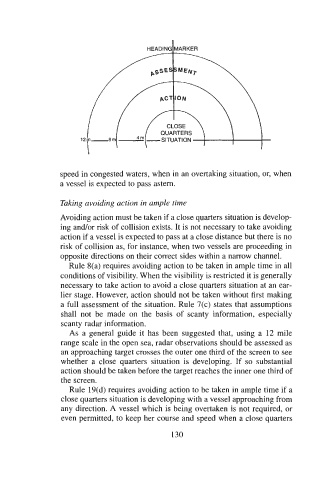
                  As  a general  guide  it has been  suggested  that,  using  a  12 mile
                range scale in the open sea, radar observations should be assessed as
                an approaching target crosses the outer one third of the screen to see
                whether  a  close  quarters  situation  is  developing.  If  so  substantial
                action should be taken before the target reaches the inner one third of
                the screen.
                  Rule 19(d) requires avoiding action to be taken in ample time if a
                close quarters situation is developing with a vessel approaching from
                any direction. A vessel which is being overtaken is not required, or
                even permitted, to keep her course and speed when a close quarters
                                           130

