


Page 150 - Collision Avoidance Rules Guide
P. 150
situation is developing. The Rules of Section I1 only apply to vessels
              in sight of one another. However, when a vessel is approaching from
              abaft the beam the relatively low rate of approach means that action
              can be taken at shorter range and yet be made in ample time.

              When action consists of  an alteration of  course

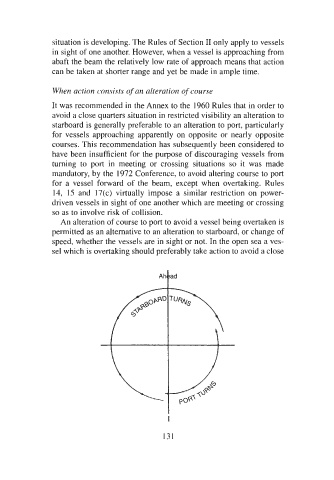
              It was recommended in the Annex to the 1960 Rules that in order to
              avoid a close quarters situation in restricted visibility an alteration to
              starboard is generally preferable to an alteration to port, particularly
              for vessels  approaching  apparently  on  opposite  or  nearly  opposite
              courses. This recommendation  has subsequently been considered to
              have been insufficient  for the purpose of discouraging vessels from
              turning  to  port  in  meeting  or  crossing  situations  so it  was  made
              mandatory, by the 1972 Conference, to avoid altering course to port
              for  a  vessel  forward  of  the  beam,  except  when  overtaking.  Rules
              14,  15  and  17(c) virtually  impose  a  similar  restriction  on  power-
              driven vessels in sight of one another which are meeting or crossing
              so as to involve risk of collision.
                An alteration of course to port to avoid a vessel being overtaken is
              permitted as an alternative to an alteration to starboard, or change of
              speed, whether the vessels are in sight or not. In the open sea a ves-
              sel which is overtaking should preferably take action to avoid a close


                                          I
                                         131

