


Page 155 - Collision Avoidance Rules Guide
P. 155
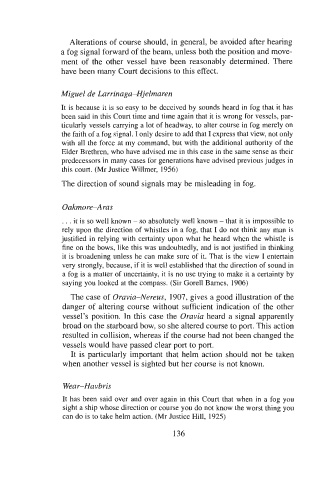
Alterations of course should, in general, be avoided after hearing
                a fog signal forward of the beam, unless both the position and move-
                ment  of  the  other  vessel  have  been  reasonably  determined.  There
                have been many Court decisions to this effect.


                Miguel de Larrinaga-Hjelmaren
                It is because it is so easy to be deceived by sounds heard in fog that it has
                been said in this Court time and time again that it is wrong for vessels, par-
                ticularly vessels carrying a lot of headway, to alter course in fog merely on
                the faith of a fog signal. I only desire to add that I express that view, not only
                with all the force at my command, but with the additional authority of the
                Elder Brethren, who have advised me in this case in the same sense as their
                predecessors in many cases for generations have advised previous judges in
                this court. (Mr Justice Willmer, 1956)
                The direction of sound signals may be misleading in fog.

                Oakmore-A ras

                . . . it is so well known - so absolutely well known - that it is impossible to
                rely upon the direction of whistles in a fog, that I do not think any man is
                justified  in relying with certainty upon what he heard when the whistle is
                fine on the bows, like this was undoubtedly, and is not justified in thinking
                it is broadening unless he can make sure of it. That is the view I entertain
                very strongly, because, if it is well established that the direction of sound in
                a fog is a matter of uncertainty, it is no use trying to make it a certainty by
                saying you looked at the compass. (Sir Gore11 Barnes,  1906)
                  The case of Oravia-Nereus,  1907, gives a good illustration of the
                danger  of  altering course without  sufficient  indication of  the other
                vessel’s position.  In this case the Oravia heard  a signal apparently
                broad on the starboard bow, so she altered course to port. This action
                resulted in collision, whereas if the course had not been changed the
                vessels would have passed clear port to port.
                  It is particularly  important that helm action  should not  be taken
                when another vessel is sighted but her course is not known.


                Wear-Havbris
                It has been said over and over again in this Court that when in a fog you
                sight a ship whose direction or course you do not know the worst thing you
                can do is to take helm action. (Mr Justice Hill,  1925)
                                            136

