


Page 156 - Collision Avoidance Rules Guide
P. 156
,,4


                Even if a signal heard forward of the beam is changed to the two
              prolonged blasts of a vessel not making way, an alteration of course
              may not be justified.
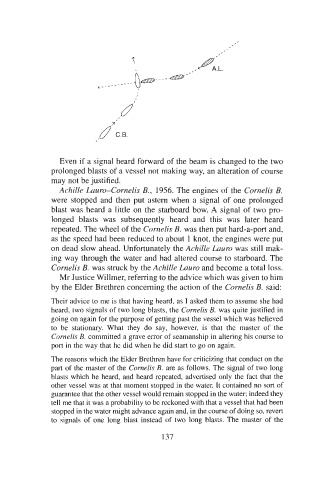
                Achille Lauro-Cornelis  B.,  1956. The engines of the Cornelis B.
              were  stopped and then put  astern  when  a  signal of  one prolonged
              blast  was heard  a little on the starboard bow. A signal of  two pro-
              longed  blasts  was  subsequently  heard  and  this  was  later  heard
              repeated. The wheel of the Cornelis B. was then put hard-a-port and,
              as the speed had been reduced to about  1 knot, the engines were put
              on dead slow ahead. Unfortunately the Achille Lauro was still mak-
              ing way through the water and had altered course to starboard. The
              Cornelis B. was struck by the Achille Lauro and become a total loss.
                Mr Justice Willmer, referring to the advice which was given to him
              by the Elder Brethren concerning the action of the Cornelis B. said:
              Their advice to me is that having heard, as I asked them to assume she had
              heard, two signals of two long blasts, the Cornelis B. was quite justified in
              going on again for the purpose of getting past the vessel which was believed
              to  be  stationary.  What  they  do  say,  however,  is  that  the  master  of  the
              Cornelis B. committed a grave error of seamanship in altering his course to
              port in the way that he did when he did start to go on again.

              The reasons which the Elder Brethren have for criticizing that conduct on the
              part of  the master of the Cornelis B. are as follows. The signal of two long
              blasts which he heard, and heard repeated, advertised only the fact that the
              other vessel was at that moment stopped in the water. It contained no sort of
              guarantee that the other vessel would remain stopped in the water; indeed they
              tell me that it was a probability to be reckoned with that a vessel that had been
              stopped in the water might advance again and, in the course of doing so, revert
              to  signals of  one long blast  instead of  two  long blasts. The  master of  the

                                         137

