


Page 457 - Compression Machinery for Oil and Gas
P. 457
Compressor System Design and Analysis Chapter  11 437


                       Flow


              Acoustic particle
              velocity excites
              shear layer


                                             Standing
                                              acoustic
                                               wave
                                         d

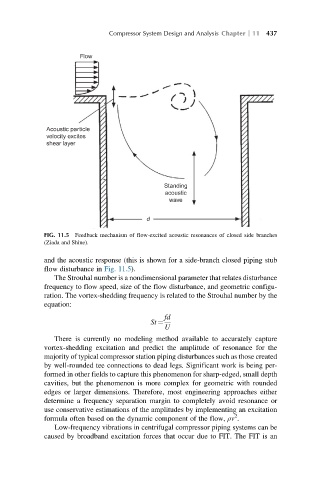
             FIG. 11.5 Feedback mechanism of flow-excited acoustic resonances of closed side branches
             (Ziada and Shine).

             and the acoustic response (this is shown for a side-branch closed piping stub
             flow disturbance in Fig. 11.5).
                The Strouhal number is a nondimensional parameter that relates disturbance
             frequency to flow speed, size of the flow disturbance, and geometric configu-
             ration. The vortex-shedding frequency is related to the Strouhal number by the
             equation:
                                              fd
                                          St ¼
                                              U
                There is currently no modeling method available to accurately capture
             vortex-shedding excitation and predict the amplitude of resonance for the
             majority of typical compressor station piping disturbances such as those created
             by well-rounded tee connections to dead legs. Significant work is being per-
             formed in other fields to capture this phenomenon for sharp-edged, small depth
             cavities, but the phenomenon is more complex for geometric with rounded
             edges or larger dimensions. Therefore, most engineering approaches either
             determine a frequency separation margin to completely avoid resonance or
             use conservative estimations of the amplitudes by implementing an excitation
                                                                2
             formula often based on the dynamic component of the flow, ρv .
                Low-frequency vibrations in centrifugal compressor piping systems can be
             caused by broadband excitation forces that occur due to FIT. The FIT is an

