


Page 157 - Crisis Communication Practical PR Strategies
P. 157
3
              8
            1 138 Crisis Communication
              Having a written statement that contains most of the information
            that you, 1) have, and 2) feel comfortable releasing, serves another
            purpose, too. It keeps you from having to repeatedly respond to
            reporters’ questions with variations of ‘I don’t know.’ Even though
            you’re not expected to have all the answers right away, such an episode
            can kill your confidence as it does away with your credibility.
              However, if the crisis continues for a while or escalates – for
            example, if injured employees later die – you will need to do a media
            update. At that point, you can start out with a prepared statement but
            you, or your executive, must be ready to take questions.


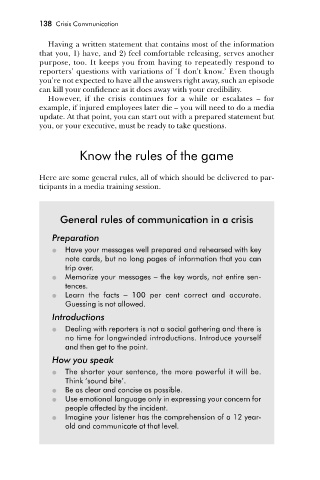
                       Know the rules of the game


            Here are some general rules, all of which should be delivered to par-
            ticipants in a media training session.


                  General rules of communication in a crisis

               Preparation

                   Have your messages well prepared and rehearsed with key
                   note cards, but no long pages of information that you can
                   trip over.
                   Memorize your messages – the key words, not entire sen-
                   tences.
                   Learn the facts – 100 per cent correct and accurate.
                   Guessing is not allowed.
               Introductions
                   Dealing with reporters is not a social gathering and there is
                   no time for longwinded introductions. Introduce yourself
                   and then get to the point.
               How you speak

                   The shorter your sentence, the more powerful it will be.
                   Think ‘sound bite’.
                   Be as clear and concise as possible.
                   Use emotional language only in expressing your concern for
                   people affected by the incident.
                   Imagine your listener has the comprehension of a 12 year-
                   old and communicate at that level.

