


Page 208 - Cultural Competence in Health Education
P. 208
186  Cultural Competence in Health Education and Health Promotion


                       (Mar í n  &  Mar í n, 1991), their gender (Wyn  &  Solis, 2001), and their religion (Brooks,
                       2004; Holt  &  McClure, 2006). Understanding the specific needs of individuals, groups,

                       or communities based on their demographic characteristics is key in assisting these
                       individuals and groups to attain a positive health outcome and in avoiding coercing
                       them to engage in activities that may run contrary to their beliefs and values.
                            Despite overwhelming evidence that behavior modifi cation cannot occur without
                       taking into account people ’ s environment and social support networks, health educa-
                       tors tend to focus almost exclusively on individuals and their needs and behaviors.
                       This approach is based on the cultural tenet that we are responsible for our own well -
                         being but unfortunately fails to take into account differences by gender, age, and eth-
                       nic group. In this regard our approach as health educators resembles that of health care
                       professionals who tend to focus on the pathophysiology of illness and give little regard
                       to the individual as a whole. This shortsighted approach fails to take into account
                       the impact of culture on the health status of individuals and may in fact diminish the

                       impact of our scientifically sound programs (Dimou, 1995; Hall, 1990; Marmot,
                       Siegrist, Theorell,  &  Feeney, 1999).
                            The professional literature suggests that a culturally appropriate approach to
                       health education requires an emphasis not only on individual behavior but also on the
                       family and the environment of the person (Airhihenbuwa, 1995a, 1995b; Anand, 2003;
                       Casken, 1999), as each of these factors contributes to the explanatory model of health
                       and disease as experienced by individuals and has an impact on perceptions, knowl-
                       edge, attitudes, and health - related behaviors (Kleinman, 1980) and also affects the
                       symbolism attached to an illness behavior. Recent professional literature also calls for
                       health educators to have a good understanding of their target individuals ’  culture if
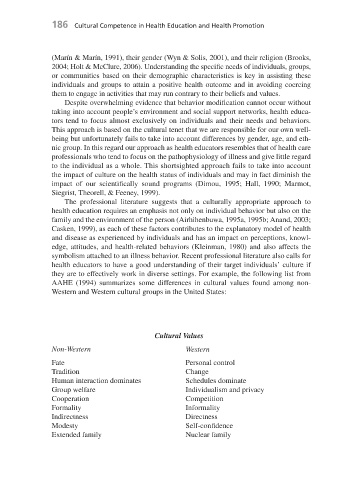
                       they are to effectively work in diverse settings. For example, the following list from
                       AAHE (1994) summarizes some differences in cultural values found among non -
                         Western and Western cultural groups in the United States:


                                                   Cultural Values
                       Non-Western                          Western

                       Fate                                 Personal control
                       Tradition                            Change
                       Human interaction dominates          Schedules dominate
                       Group welfare                        Individualism and privacy
                       Cooperation                          Competition
                       Formality                            Informality
                       Indirectness                         Directness
                       Modesty                              Self-confi dence
                       Extended family                      Nuclear family


                                                                                                  7/1/08   3:00:56 PM
          c10.indd   186                                                                          7/1/08   3:00:56 PM
          c10.indd   186

