


Page 210 - Cultural Competence in Health Education
P. 210
188  Cultural Competence in Health Education and Health Promotion


                       the field. Most recently, AAHE has released a position statement on cultural competency

                       in health education (AAHE, 2006), which states that  “ health educators must strive to
                       achieve cultural competency by understanding the meaning of culture, its complexity
                       within each group, and its effect on health decisions and practices ”  (p. 1).

                           The Society for Public Health Education (SOPHE) has identified the elimination of
                       health disparities as one of its top three advocacy priorities for 2006. As part of these
                       efforts, two SOPHE journals,  Health Education  &   Behavior   and   Health Promotion
                       Practice,  published materials based on presentations at an invitational summit titled
                         Health Disparities and Social Inequities: Framing a Transdisciplinary Research Agenda
                       in Health Education.  Articles from these journals are cited throughout this book. And
                       presentations to the SOPHE Web seminar titled  “ On the Road from Research to Practice:
                       Eliminating Racial and Ethnic Health Disparities, ”  have been made available on the
                       SOPHE Web site ( http://www.sophe.org ). Results from these seminars have yielded ten
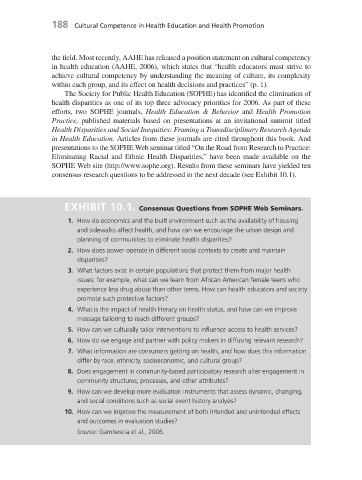
                       consensus research questions to be addressed in the next decade (see Exhibit  10.1 ).


                          EXHIBIT 10.1.  Consensus Questions from SOPHE Web Seminars.
                             1.  How do economics and the built environment such as the availability of housing
                              and sidewalks affect health, and how can we encourage the urban design and
                              planning of communities to eliminate health disparities?
                             2.  How does power operate in different social contexts to create and maintain
                              disparities?
                             3.  What factors exist in certain populations that protect them from major health
                              issues; for example, what can we learn from African American female teens who
                              experience less drug abuse than other teens. How can health educators and society
                              promote such protective factors?
                             4.  What is the impact of health literacy on health status, and how can we improve
                              message tailoring to reach different groups?
                             5.  How can we culturally tailor interventions to infl uence access to health services?
                             6.  How do we engage and partner with policy makers in diffusing relevant research?
                             7.  What information are consumers getting on health, and how does this information
                              differ by race, ethnicity, socioeconomic, and cultural group?
                             8.  Does engagement in community-based participatory research alter engagement in
                              community structures, processes, and other attributes?
                             9.  How can we develop more evaluation instruments that assess dynamic, changing,
                              and social conditions such as social event history analysis?
                           10.  How can we improve the measurement of both intended and unintended effects
                              and outcomes in evaluation studies?
                              Source: Gambescia et al., 2006.


                                                                                                  7/1/08   3:00:56 PM
          c10.indd   188                                                                          7/1/08   3:00:56 PM
          c10.indd   188

