


Page 249 - Curvature and Homology
P. 249
any order provided the Ricci curvature defined by the given differentials
        is  negative.  In  fact,  the  condition  that  the  differentials be  df-closed
        ensured  the existence of  a  Kaehler  metric  relative to which the  Ricci
        curvature was non-positive.  By  restricting the independence assumption
        on  the  holomorphic  differentials we  may  drop  the  restriction  on  the
        curvature entirely, thereby  obtaining interesting consequences from an
        algebraic point of  view.
          We consider a compact complex manifold M of complex dimension n.
        No assumption regarding a metric will  be  made,  that is, in particular,
        M need  not  be  a  Kaehler  manifold.  Let  a  be  a holomorphic form of
        bidegree (1,O) and X a holomorphic (contravariant) vector field on M.
        Then,  since  M is  compact
                                i(X)a = const.,

        for, i(X)a is a holomorphic function on M. If we assume that there are
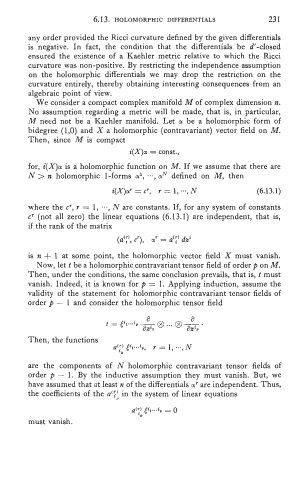
        N > n holomorphic  1-forms al, ..., aN defined  on  M,  then


        where the cr, r  = 1, --., N are constants. If, for any system of  constants
        cr (not  all  zero) the linear  equations (6.13.1)  are independent,  that  is,
        if  the rank of the matrix


        is n + 1 at  some point,  the holomorphic vector field  X must  vanish.
          Now, let t be a holomorphic contravariant tensor field of order p on M.
        Then, under the conditions, the same conclusion prevails, that is, t must
        vanish.  Indeed, it is known for p  = 1. Applying induction,  assume the
        validity of  the statement  for holomorphic contravariant tensor fields of
        order p  - 1 and consider the holomorphic tensor  field


        are  the  components  of  N  holomorphic  contravariant  tensor  fields  of
        order p  - 1.  By  the  inductive  assumption  they  must  vanish.  But,  we
        have assumed that at least n of the differentials ar are independent. Thus,
        the coefficients of  the a(;: in the system of  linear equations


        must vanish.

