


Page 251 - Curvature and Homology
P. 251
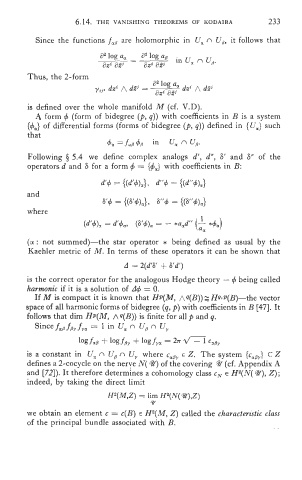
Since  the  functions fa8  are  holomorphic  in  Ua n U8,  it follows that
                         a2 log a,  - a2 log a@
                         ---        asi  a$
                          azi  a~i         in U,  n Ug.
        Thus, the 2-form
                                      a2 log a,
                        yij* dz'  A d9 = = d9
                                             dzi
                                                A
                                      azi a9
        is defined over the whole  manifold M  (cf.  V.D).
          4 form 4 (form  of  bidegree (p, 9)) with  coefficients in B  is a system
        {$,I differential forms (forms of  bidegree (p, q)) defined in  {U,}  such
            of
        that
        Following 5  5.4  we  define  complex  analogs  d',  d",  8'  and  6"  of  the
        operators d and 6 for a form 4 = {+,I  with coefficients in B:


        (a : not  summed)-the   star  operator *  being  defined  as  usual  by  the
        Kaehler  metric of  M. In terms of  these operators it can be shown that
                               A  = 2(d'S1 + S'd')

        is the correct operator for the analogous Hodge theory -  being called
        harmonic if  it is a solution of  A$  = 0.
         If M is compact it is known that Hp(M,  A@(B)) g HqpP(B)-the  vector
       space of all harmonic forms of bidegree (q, p) with coefficients in B [47].  It
        follows that dim Hp(M,  A q(B)) is finite for all p  and q.
         Since fa@ fay  fya = 1 in  Ua n Up n U,,


        is a constant in  U,  n Ug n U,,  where  caBy E 2. The system  {cap,)  C Z
        defines a 2-cocycle on the nerve N( 8) of the covering  % (cf. Appendix A
        and [72]). It therefore determines a cohomology class cN  E H2(N( a), 2);
        indeed, by taking the direct limit
                           H2(M,Z) = lim H2(N(%),Z)
                                     4
        we obtain an element c = c(B) E H2(M, Z) called the characteristic class
        of the principal  bundle  associated with B.

