


Page 257 - Curvature and Homology
P. 257
EXERCISES

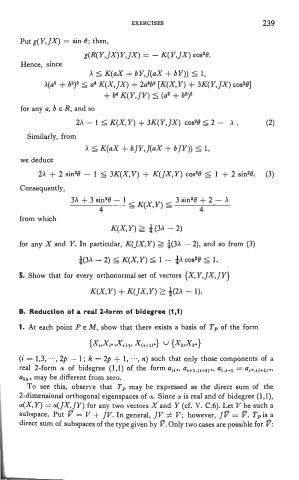
      Put g(Y, JX)  = sin 8; then,
                     g(R(Y, JX)Y, JX)  = - K(Y, JX) eoss8.
      Hence,  since
                       h 5 K(aX + by, J(aX + by)) 5 1,
            h(as + b2)= 5 d K(X, JX) + 2asba [K(X,Y) + 3K(Y, JX) cos'fl
                          + P K(Y, JY)  5 (as + be)'
      for any a, b E R, and so
                   2h - 1 5 K(X,Y) + 3K(Y, JX)  cos28 5 2 - h .

        Similarly, from
                       5 K(aX + b JY,J(aX + b JY))  5 1,
      we deduce


      Consequently,


      for any X and  Y.  In particular, Kt JX,Y)  2 i(3h - 2), and so from (3)


      5.  Show that for every orthonormal set of  vectors {x,Y, Jx, JY}


      B.  Reduction of a real 2-form of  bidegree (1.1)

      1.  At each point P E M, show that there exists a basis of  Tp of  the form


      (i = 1,3, ..a,  2p - 1 ; k = 2p + 1, ..., n)  such that only those components of a
      real  2-form  a  of  bidegree  (1,l) of the  form a,,,,  ai+l,(i+l) +,  at.i+l = ai+.(i+l)
      a,,,  may be different from zero.
       To see  this,  observe  that  Tp may  be  expressed  as the  direct sum of  the
      2-dimensional orthogonal eigenspaces of a. Since a is real and of bidegree (1,1),
      ,1(X,Y) = a( JX, JY)  for any two vectors X and Y (cf. V.  C.6). Let V be such a
      subspace.  Put v = V + JV.  In general, JV  ;f V;  however, JV = v. Tpis a
      direct sum of subspaces of the type given by v. Only two cases are possible for v:

