


Page 260 - Curvature and Homology
P. 260
242     VI.  CURVATURE  AND  HOMOLOGY:  KAEHLER  MANIFOLDS

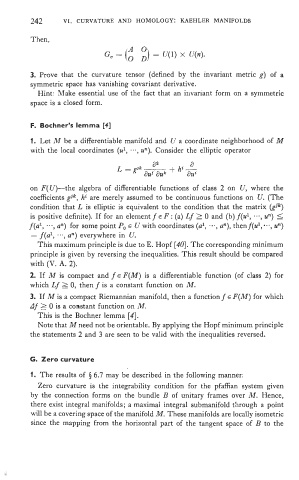
        Then,


        3.  Prove  that  the  curvature  tensor  (defined  by  the  invariant  metric g) of  a
        symmetric space has vanishing covariant derivative.
          Hint:  Make essential use of the fact that  an illvariant form on a symmetric
        space is a closed form.

        F.  Bochner's lemma [4]

        1.  Let M  be a differentiable manifold and  U a coordinate neighborhood of  M
        with  the local  coordinates (ul, ..., un). Consider the elliptic operator


        on F(U)-the   algebra of  differentiable functions  of  class  2  on  U, where  the
        coefficients gjk, hi  are merely assumed to be continuous functions on  U.  (The
        condition that L is elliptic is equivalent to the condition that  the matrix Vk)
        is positive definite). If  for an element f E F : (a) Lf  2 0 and (b) f(ul,  *.-, un) 5
        f (a1, .. ., an) for some point Po E U with coordinates (a1, . ., an), then f (ul,  .., un)
         = f(al,  -.., an) everywhere in  U.
          This maximum principle is due to E. Hopf [40]. The corresponding minimum
        principle is given by reversing the inequalities. This result should be compared
        with (V. A.  2).
        2.  If  M  is compact  and f e F(M) is a  differentiable function  (of  class 2)  for
        which Lf  2 0, then f is a constant function on M.
        3.  If M is a compact Riemannian manifold, then a function f E F(M) for which
        Af  2 0 is a constant function on M.
          This is the Bochner lemma [#I.
          Note that M need not be orientable. By applying the Hopf minimum principle
        the statements 2 and 3 are seen to be valid with the inequalities reversed.

        G.  Zero curvature

        1.  The results of  5 6.7  may be described in the following manner:
          Zero  curvature  is  the  integrability  condition  for  the  pfaffian  system given
        by  the connection forms on  the bundle  B of  unitary  frames over  M.  Hence,
        there exist integral manifolds; a maximal  integral submanifold through  a point
        will be a covering space of the manifold M. These manifolds are locally isometric
 i       since the mapping  from the horizontal part  of  the tangent  space of  B to the

