


Page 125 -
P. 125
104    CHAPTER 9 Align and business value


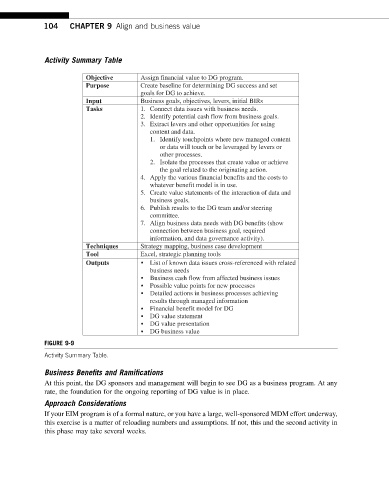
             Activity Summary Table

                         Objective      Assign financial value to DG program.
                         Purpose        Create baseline for determining DG success and set
                                        goals for DG to achieve.
                         Input          Business goals, objectives, levers, initial BIRs
                         Tasks          1. Connect data issues with business needs.
                                        2. Identify potential cash flow from business goals.
                                        3. Extract levers and other opportunities for using
                                           content and data.
                                           1. Identify touchpoints where new managed content
                                             or data will touch or be leveraged by levers or
                                             other processes.
                                           2. Isolate the processes that create value or achieve
                                             the goal related to the originating action.
                                        4. Apply the various financial benefits and the costs to
                                           whatever benefit model is in use.
                                        5. Create value statements of the interaction of data and
                                           business goals.
                                        6. Publish results to the DG team and/or steering
                                           committee.
                                        7. Align business data needs with DG benefits (show
                                           connection between business goal, required
                                           information, and data governance activity).
                         Techniques     Strategy mapping, business case development
                         Tool           Excel, strategic planning tools
                         Outputs           List of known data issues cross-referenced with related
                                           business needs
                                           Business cash flow from affected business issues
                                           Possible value points for new processes
                                           Detailed actions in business processes achieving
                                           results through managed information
                                           Financial benefit model for DG
                                           DG value statement
                                           DG value presentation
                                           DG business value
             FIGURE 9-9
             Activity Summary Table.

             Business Benefits and Ramifications

             At this point, the DG sponsors and management will begin to see DG as a business program. At any
             rate, the foundation for the ongoing reporting of DG value is in place.
             Approach Considerations

             If your EIM program is of a formal nature, or you have a large, well-sponsored MDM effort underway,
             this exercise is a matter of reloading numbers and assumptions. If not, this and the second activity in
             this phase may take several weeks.

