


Page 121 -
P. 121
100    CHAPTER 9 Align and business value


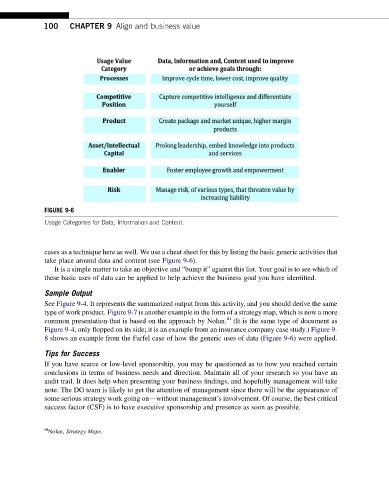
             FIGURE 9-6
             Usage Categories for Data, Information and Content.


             cases as a technique here as well. We use a cheat sheet for this by listing the basic generic activities that
             take place around data and content (see Figure 9-6).
                It is a simple matter to take an objective and “bump it” against this list. Your goal is to see which of
             these basic uses of data can be applied to help achieve the business goal you have identified.
             Sample Output

             See Figure 9-4. It represents the summarized output from this activity, and you should derive the same
             type of work product. Figure 9-7 is another example in the form of a strategy map, which is now a more
                                                                iii
             common presentation that is based on the approach by Nolan. (It is the same type of document as
             Figure 9-4, only flopped on its side; it is an example from an insurance company case study.) Figure 9-
             8 shows an example from the Farfel case of how the generic uses of data (Figure 9-6) were applied.
             Tips for Success

             If you have scarce or low-level sponsorship, you may be questioned as to how you reached certain
             conclusions in terms of business needs and direction. Maintain all of your research so you have an
             audit trail. It does help when presenting your business findings, and hopefully management will take
             note. The DG team is likely to get the attention of management since there will be the appearance of
             some serious strategy work going ondwithout management’s involvement. Of course, the best critical
             success factor (CSF) is to have executive sponsorship and presence as soon as possible.


             iii
              Nolan, Strategy Maps.

