


Page 116 -
P. 116
Overview     95


                  The team can then determine where the benefits are that have been identified and start to discover
               points where DG can affect or ensure usefulness of data and content. After a thorough understanding of
               the business needs, metrics, and organization goals, they can go to the last activity in this phase and
               place a value on the organization’s DG program.
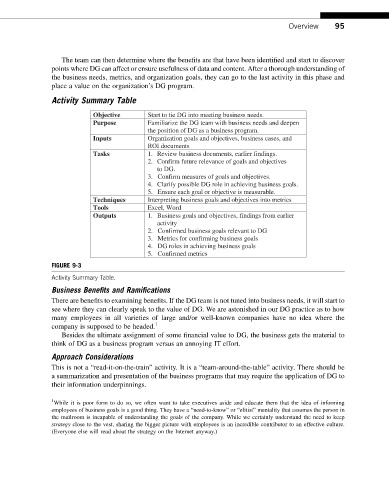
               Activity Summary Table

                           Objective      Start to tie DG into meeting business needs.
                           Purpose        Familiarize the DG team with business needs and deepen
                                          the position of DG as a business program.
                           Inputs         Organization goals and objectives, business cases, and
                                          ROI documents
                           Tasks          1. Review business documents, earlier findings.
                                          2. Confirm future relevance of goals and objectives
                                             to DG.
                                          3. Confirm measures of goals and objectives.
                                          4. Clarify possible DG role in achieving business goals.
                                          5. Ensure each goal or objective is measurable.
                           Techniques     Interpreting business goals and objectives into metrics
                           Tools          Excel, Word
                           Outputs        1. Business goals and objectives, findings from earlier
                                             activity
                                          2. Confirmed business goals relevant to DG
                                          3. Metrics for confirming business goals
                                          4. DG roles in achieving business goals
                                          5. Confirmed metrics
               FIGURE 9-3
               Activity Summary Table.
               Business Benefits and Ramifications
               There are benefits to examining benefits. If the DG team is not tuned into business needs, it will start to
               see where they can clearly speak to the value of DG. We are astonished in our DG practice as to how
               many employees in all varieties of large and/or well-known companies have no idea where the
                                            1
               company is supposed to be headed.
                  Besides the ultimate assignment of some financial value to DG, the business gets the material to
               think of DG as a business program versus an annoying IT effort.
               Approach Considerations

               This is not a “read-it-on-the-train” activity. It is a “team-around-the-table” activity. There should be
               a summarization and presentation of the business programs that may require the application of DG to
               their information underpinnings.

               1
                While it is poor form to do so, we often want to take executives aside and educate them that the idea of informing
               employees of business goals is a good thing. They have a “need-to-know” or “elitist” mentality that assumes the person in
               the mailroom is incapable of understanding the goals of the company. While we certainly understand the need to keep
               strategy close to the vest, sharing the bigger picture with employees is an incredible contributor to an effective culture.
               (Everyone else will read about the strategy on the Internet anyway.)

