


Page 125 - Design of Solar Thermal Power Plants
P. 125
2.9 MEASURING INSTRUMENT               111


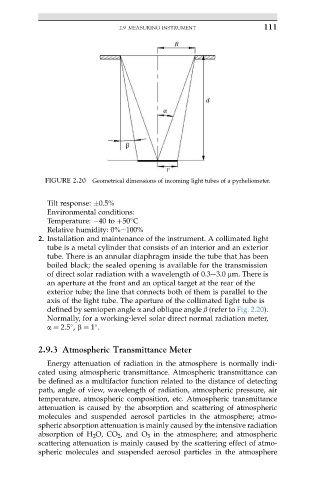
             FIGURE 2.20  Geometrical dimensions of incoming light tubes of a pyrheliometer.


              Tilt response:  0.5%
              Environmental conditions:
              Temperature:  40 to þ50 C

              Relative humidity: 0%e100%
           2. Installation and maintenance of the instrument. A collimated light
              tube is a metal cylinder that consists of an interior and an exterior
              tube. There is an annular diaphragm inside the tube that has been
              boiled black; the sealed opening is available for the transmission
              of direct solar radiation with a wavelength of 0.3e3.0 mm. There is
              an aperture at the front and an optical target at the rear of the
              exterior tube; the line that connects both of them is parallel to the
              axis of the light tube. The aperture of the collimated light tube is
              defined by semiopen angle a and oblique angle b (refer to Fig. 2.20).
              Normally, for a working-level solar direct normal radiation meter,
              a ¼ 2.5 , b ¼ 1 .


           2.9.3 Atmospheric Transmittance Meter

              Energy attenuation of radiation in the atmosphere is normally indi-
           cated using atmospheric transmittance. Atmospheric transmittance can
           be defined as a multifactor function related to the distance of detecting
           path, angle of view, wavelength of radiation, atmospheric pressure, air
           temperature, atmospheric composition, etc. Atmospheric transmittance
           attenuation is caused by the absorption and scattering of atmospheric
           molecules and suspended aerosol particles in the atmosphere; atmo-
           spheric absorption attenuation is mainly caused by the intensive radiation
           absorption of H 2 O, CO 2 , and O 3 in the atmosphere; and atmospheric
           scattering attenuation is mainly caused by the scattering effect of atmo-
           spheric molecules and suspended aerosol particles in the atmosphere

