


Page 256 - Design of Solar Thermal Power Plants
P. 256
4.2 PRINCIPLES FOR CONCENTRATION FIELD LAYOUT  239

           solar beam concentration calculation for a concentrator with errors
           extremely difficult; also, precision is low, so experimental values may be
           comparatively more precise. Due to the different temperature strains of
           the concentrator support frame under different temperatures, a good
           equation must consider the influence of temperature on optical concen-
           tration precision or give separate calculation equations for winter and
           summer in estimating concentrator output energy during winter and
           summer:

           4.2.5 General Principle for Heliostat Field Layout

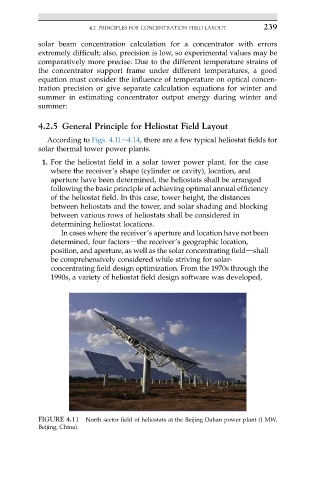
              According to Figs. 4.11e4.14, there are a few typical heliostat fields for
           solar thermal tower power plants.
            1. For the heliostat field in a solar tower power plant, for the case
               where the receiver’s shape (cylinder or cavity), location, and
               aperture have been determined, the heliostats shall be arranged
               following the basic principle of achieving optimal annual efficiency
               of the heliostat field. In this case, tower height, the distances
               between heliostats and the tower, and solar shading and blocking
               between various rows of heliostats shall be considered in
               determining heliostat locations.
                  In cases where the receiver’s aperture and location have not been
               determined, four factorsdthe receiver’s geographic location,
               position, and aperture, as well as the solar concentrating fielddshall
               be comprehensively considered while striving for solar-
               concentrating field design optimization. From the 1970s through the
               1990s, a variety of heliostat field design software was developed,


           FIGURE 4.11  North sector field of heliostats at the Beijing Dahan power plant (1 MW,
           Beijing, China).

